
MMA Permanent Collection
Welcome to the Permanent Collection here at the Muskegon Museum of Art. While it is not practical for us to show you everything in our collection, we do hope to highlight a few of works here that might whet your appetite. We hope you enjoy your visit, and encourage you to ask us questions or make suggestions. We hope to see you at the Museum!


-
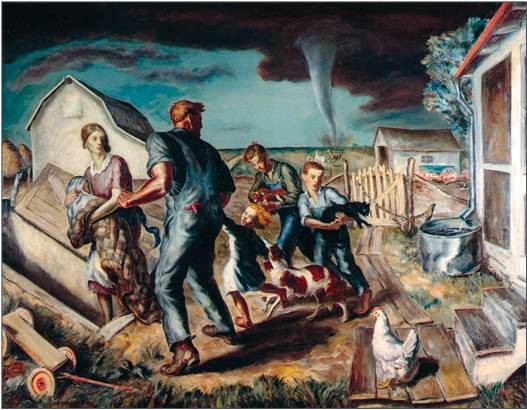
John Steuart Curry (American, 1897-1946)
The Tornado (Tornado Over Kansas)
Oil on canvas, 1929
Hackley Picture Fund purchase,
1935.4The Tornado (Tornado Over Kansas) and Baptism in Kansas are arguably John Steuart Curry’s two most famous paintings. Heavily reproduced, both have been used not only to define Curry’s career, but the entire Regionalist art movement. The Tornado (Tornado Over Kansas) speaks to a distinct period of U.S. history and the struggle to define the “American” style of art. The Tornado has been celebrated from its first public display, receiving a second place award at the “Century of Progress” exhibition in 1930. The painting has appeared in over 150 publications since its debut, including school textbooks, art magazines, art history texts, and the Hollywood blockbuster Twister. The Tornado first captured the eye of the nation in 1934, in the pages of Time magazine, where the painting was illustrated in an article about the new U.S. style painters. The article included biographies on Thomas Hart Benton, Reginald Marsh, John Steuart Curry, and Grant Wood.
Full of heightened drama and mythic figures, The Tornado was painted while Curry lived in Connecticut and is inspired by the memories of his youth and his efforts to define an “American” style of art. The house and barn look much like those on the farm he grew up on and are used here to typify the Midwest homestead. The tornado is the ultimate expression of the power the weather holds over life in the Midwest and on its farms in particular—its destructive force cannot be controlled or prevented and its visual presence evokes fear and danger. According to his widow, Curry never saw a tornado himself, but it is impossible to live in Kansas and not know the very real possibility one, and the sense of dread that comes with every violent storm. Curry would certainly have heard numerous accounts of devastating tornados and has depicted this one based upon spoken and photographic accounts.
Curry worked as an illustrator, and the dramatic narrative speaks to conveying a story through art. The figures in this drama are icons for the prototypical family in Curry’s Kansas. The father is central, rising over the other figures in a place of command, his square jaw and heroic profile set against the fury of the storm, his well muscled arm cocked against the threat. His wife is pale and frightened, clutching her child to her breast and looking to her husband for support. The boys are smaller versions of their father, serving as rescuers to the family’s cat and dogs. The last child, a girl, looks up to her father as protector, as he pulls her by the hand to safety. The entire family is grouped into a circle, heightening their connection to each other and planting them firmly amidst the tilting angles of the farm around them. Their circular configuration also serves to repeat the motion of the approaching tornado.
The Tornado (Tornado Over Kansas) was purchased by the Hackley Art Gallery from Feragil Galleries, through the efforts of Maynard Walker, an aggressive proponent of Regionalist art. At the time the Curry was under consideration it was accompanied by a painting by Thomas Hart Benton. The Benton was not purchased, nor were the additional Curry paintings that Walker offered at the close of the sale of Tornado Over Kansas. While in retrospect the purchase of the Curry seems an obvious choice, and the decline of the Benton and another Curry short-sighted, in 1935 the paintings were new, the careers of the artists promising but not celebrated, and the movement of Regionalism still in its early stages and derided by the Modernist critics in New York. Today, The Tornado (Tornado Over Kansas) is a national treasure and one of our most prominent works.
In 1931, Michigan-born real estate broker H. Tracy Kneeland, who had recently moved to Hartford, Connecticut, Curry's home state, offered to purchase the painting, as it stirred memories of his own childhood in St. Louis, Gratiot County. In a letter to Curry, Kneeland wrote:
"I find … a certain native quality which interests me because I was born and brought up in Michigan and while I have never seen a tornado of this kind I can well remember school being let out and running for dear life for home, with the branches torn off the trees … the whole picture seems to strike a home chord in me."
The “home chord” that Curry awakened in Kneeland reflected a growing desire among American artists to picture a simpler time in the wake of World War I and at the onset of the Great Depression. Rejecting European-bred modernism and abstraction, many artists sought to create, in realistic terms, an indigenous art, perceived in the American consciousness to thrive in the pioneer-spirit virtues of the nation’s heartland.
The Tornado (Tornado Over Kansas) found its ultimate home in Michigan, but not with Mr. Kneeland. In 1935, the MMA acquired what became one of the great icons of American Regionalism. John Steuart Curry, Grant Wood, and Thomas Hart Benton were the most influential of the American Scene painters.
-
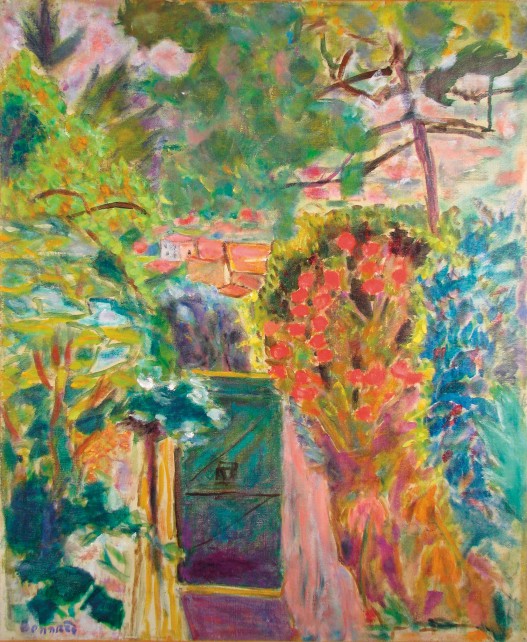
Pierre Bonnard (French, 1867-1947)
La porte de la villa du Bosquet au Cannet (Gate at the Villa Bosquet in Le Cannet)
Oil on canvas, 1944
Gift of the L.C. and Margaret Walker Foundation, 1975.25Born and educated in the environs of Paris, Pierre Bonnard began to make regular winter visits to the French Riviera in the early 1900s. He discovered Le Cannet, a picturesque town adjacent to the resort of Cannes, in 1922. In 1926, he purchased a villa called Le Bosquet, perched in the hills above the village.
Bonnard lived at the villa for the next 21 years until his death in 1947. The villa remained a reserve of sparse simplicity and seclusion that served the creative needs of the artist. From this haven of solitude, Bonnard explored the endless visual treasure of the region and painted every corner and angle of the villa and its gardens. Le Bosquet was to Bonnard what Giverny was to Monet.
Bonnard painted La porte de la villa du Bosquest au Cannet three years before his death. He revels in the view from the villa’s terrace to the red-roofed houses of Le Cannet, stretching to the far reaches of the Cote d’Azur below. The garden gate centers the composition, its rectangular structure standing firm against the riotous chorus of color and lush vegetation that is barely contained within the canvas. The gate, for Bonnard, held great meaning. While it provided access to the outside world, it also enclosed his private paradise where, with an unrestrained brush, he transposed the tangle and tumble of flower and branch in fragrant, dreamlike abandon.
Elizabeth Catlett (American b. 1915)
Glory
Cast bronze, 1981
Drs. Osbie and Anita Herald Fund purchase,
2000.1Elizabeth Catlett’s work is bold and powerful, shaped by her social viewpoint to reveal the strength, character, and struggle of African Americans. Glory represents a frequent theme in Catlett’s work, transforming the idealized classical bust into the image of an African American woman; and, in so doing, reveals a powerful dignity, serenity, and hope.
In 1931 Catlett won a scholarship to study art at the Carnegie Institute of Technology, but was rejected admission due to her race. Instead, she attended Howard University and studied under Lois Mailou Jones. While at Howard she worked briefly for the WPA. After graduating, she worked for two years as a teacher in Durham, North Carolina where, alongside NAACP attorney Thurgood Marshall, she fought for equal wages for Black teachers.
Frustrated by the segregated South, Catlett left to study at the University of Iowa under Grant Wood. Wood’s encouragement transformed the direction of her work into one that would explore and celebrate African American culture and the lives of women. Catlett was the first student to earn an MFA in Sculpture from the university and her thesis piece, a limestone sculpture entitled Mother and Child, won first prize in sculpture at the American Negro Exposition in Chicago. While in Chicago she met her first husband, the artist Charles White.
Alfred Sisley (1839-1899)
The Seine at St. Mammes
Oil on canvas, c.1867-69
Gift of Martin A. Ryerson on the 20th anniversary of the Hackley Art Gallery, 1932
Alfred Sisley’s La Seine à St. Mammès was a gift of Chicago civic leader, arts patron, and connoisseur Martin Ryerson, Jr. He was an honorary trustee of the Hackley Art Gallery board and son of Martin Ryerson, Sr., one of Muskegon’s early lumber barons. While Ryerson, Jr. did not choose to give the Gallery one of his Monets, the Sisley represents Monet’s abiding influence. Indeed Monet and Sisley often painted together. The Seine was a favorite subject, exemplified in Sisley’s view of the river’s sparkling waters framed by a grand, vigorously brushed tree and the shadows cast from its overarching branches.
This subject was an unusual one for Sisley. However, in 1880 and again in 1896 and 1897, Monet painted a series of works devoted to similar tree-lined riverbanks. As the MMA’s Sisley predates these paintings, perhaps La Seine à St. Mammès was a direct influence upon Monet’s river scenes.
Dale Chihuly (American, b. 1941)
Cobalt Blue Persian Set with Cadmium Red Lip Wraps
Blown glass, 1972
Gift of the SPX Corporation, 2002.3a-n
photo by Frederic A. Reinecke
Joos van Cleve (Flemish, c. 1485-1541)
Saint Jerome in Penitence
Oil on panel, c.1516-1518
Hackley Picture Fund purchase, 1940.47
Winslow Homer (American, 1836-1910)
Answering the Horn
Oil on canvas, 1876
Hackley Picture Fund Purchase, 1927.2
After a brief apprenticeship with a lithographer, Winslow Homer became a freelance illustrator for Ballou’s Pictorial in Boston, then for Harper’s Weekly in New York in 1859. Harper’s Weekly sent him to the front when the Civil War broke out, resulting in some of the most important visual reports on the war in print. Homer’s wood engravings depicted the war dispassionately, showing the mundane activities of the soldiers as often as the battles and conflicts. After the war Homer took up painting and spent time in Paris in 1866 and 1867 but, except for some Barbizon influence, was largely unchanged by the experience. Homer’s early work was often painted plein-air and depicted young men and women or children playing and working outside. His interest in the outdoors and in a simple, agrarian lifestyle, are typified in Answering the Horn, painted in 1876. In 1873 Homer began to paint in watercolor as well and used it as often as oil. Homer’s career changed markedly with a trip to the coast of England in 1881 and 1882, where the artist encountered the majesty and fury of the sea and the struggle of men and women against its power. Homer settled at Prout’s Neck in Maine along the rocky coast and the sea remained his major focus for the duration of his career.
Edward Hopper (American, 1882-1967)
New York Restaurant
Oil on canvas, c. 1922
Hackley Picture Fund purchase, 1936.12
Edward Hopper studied under Robert Henri and Kenneth Hayes Miller at the New York School of Art from 1900 to 1906 and also had some contact with William Merritt Chase. He made three trips to Europe, but did not enroll for formal study. Hopper was included in the 1913 Armory Show but after the exhibit he abandoned painting for the next decade, making a living as a commercial artist and refining his art through etchings and watercolors. In the early 1920s a watercolor, The Mansard Roof, was exhibited and purchased by the Brooklyn Art Museum. It laid out what would become the hallmarks of Hopper’s work: a precise sense of location; clear, harsh light; strong geometric elements; and a sense of loneliness and melancholy. His subtle observations of American life made Hopper a pivotal figure in the development of American art. New York Restaurant comes out of Hopper’s early career. While the scene is crowded, the woman in the red hat seems removed and distant, uninvolved with the man who sits with her. Hopper spoke of this painting in a letter to the MMA dated January 9, 1937: "The picture New York Restaurant was painted about 1922 – not later at any rate. In a specific and concrete sense, the idea was to attempt to make visual the crowded glamour of a New York restaurant during the noon hour. I am hoping that ideas less easy to define have, perhaps, crept in also."
William Sonntag
William Sonntag was born in rural Pennsylvania and at an early age aspired to be a landscape artist. After failed apprenticeships to a carpenter and architect, Sonntag moved to Cincinnati, where he is thought to have studied at the Cincinnati Academy of Fine Arts. By the mid-40s he was established as an itinerant painter, selling paintings and sketches as he traveled the Ohio Valley. A storefront exhibition in Cincinnati drew the attention of the Baltimore and Ohio Railroad, which commissioned the artist in 1846 to paint a series of views along the railroad’s route, in hopes of attracting tourists and settlers. In 1855 Sonntag traveled to Florence to study for a year, then settled in New York where he resided permanently after 1860. He was awarded full academic status in the National Academy of Art in 1862.
Sonntag’s early career was markedly influenced by Thomas Cole and the Hudson River aesthetic, of which this painting is a fine example. Depicting a rugged, untamed landscape bereft of human presence, this painting embraces the mid-19th century belief that art was an interpreter of nature, which in turn was an interpreter of God. Celebrating meditation of the divine, landscape painting revealed the face of God in every aspect of nature and is most notably here in the distant, inaccessible mountain form rising from the mists, a metaphor for an awesome, monotheistic deity. The three trees in the bottom left of the painting might also be interpreted as three crosses. The depiction of such virgin landscapes also instilled in American viewers a sense of nationalist pride as they contemplated the majesty of their land and the vast potential for expansion.
After 1860 Sonntag’s style matured and into the 1870s he enjoyed substantial artistic recognition. Upon his death in 1900 his works became largely forgotten, awaiting the current renewed interest in 19th century American painting.
Severin Roesen
Little is known about Roesen, though his paintings are well recognized for their 19th century popularity and wide use as “dining room pictures.” Thought to have been born in Germany around 1815, Roesen likely trained as a porcelain or enamel painter and is recorded as having displayed a painting in Cologne in 1847. In 1848 he immigrated to New York and immediately offered his paintings for view at the American Art Union. While still lifes had a tradition in American Art, Roesen’s work achieved a new height of popularity, and was quickly purchased by New York households for display. It is speculated he ran a workshop while in New York to keep up with demand. By 1850 Roesen had married, but that year left his family to wander New York and Pennsylvania before settling in Williamsport, Pennsylvania in 1862. Williamsport was a prosperous logging town and Roesen enjoyed a following during his years there. In 1872 he disappeared, leaving a mystery as to his destination and ultimate end. He was rumored to have died on the steps of a public building in New York or in a poorhouse in Philadelphia.
The still life has been a theme in art since the early Renaissance, though it is best recognized from the 17th and 18th century Dutch tradition. Still life served as both a celebration of the bounty of nature and as an allegory or metaphor for spiritual and religious themes. The appearance of rot or decay in the still life bespoke the ongoing struggle between good and evil. While the still life’s prominence had faded in Europe by the 19th century, it enjoyed great popularity in America, especially among the general populace. For his collectors and admirers, Roesen’s paintings were celebrations of nature’s bounty and of the blessings of the New World.
Charles Webster Hawthorne
Charles Webster Hawthorne was an extremely influential figure in Provincetown, Massachusetts, both through his writings and his teachings at the Cape Cod School of Art, which he established in 1899. He studied at the National Academy of Design in New York City and served as a studio assistant to William Merritt Chase at his Shinnecock Hills Long Island School. Hawthorne was also a founding member of the Provincetown Art Association in 1914.
While trained in the Academic tradition, Hawthorne’s ideas of working out-of-doors, and the move toward a more open brushstroke are an introduction to the Impressionist style that was making its way into the United States. Students at his Cape Cod School of Art took with them, among other things, the Impressionist idea that colors should create the form in a work and that the composition of a work is to dominate over all else.
The subjects of Hawthorne’s works explore the human experience. In Youth, Hawthorne pairs a young man and woman in a dark, moody landscape.
Willard Leroy Metcalf
In 1859, Willard Leroy Metcalf was born in Lowell, Massachusetts – the home of the famous American artist, Winslow Homer. Metcalf’s artistic career began with his studies at the art school of the Museum of Fine Arts in Boston. From 1876 to 1877 he was the student of George Loring Brown, a prominent landscape painter of Boston, and later continued his studies in Paris at the Academie Julian in 1884. It was there Metcalf encountered many well-known Impressionist painters, such as Robert Reid, Theodore Robinson, and Claude Monet. While in Paris, Metcalf was awarded an honorable mention at the Salon of 1888. Metcalf took the French Impressionist style with him when he returned to the United States, and became highly successful in magazine and book illustrating in the 1890s.
Metcalf gave up his illustration career at the age of 40 to spend a year in the woods in Maine and to devote his time exclusively to painting. Metcalf continued painting in New York until his death in 1925. Most of his works are representations of New England, with most of the focus being placed on the natural setting, rather than people or man-made subjects.
Metcalf’s career as an illustrator combines well with the stylistic functions of Impressionism. The trees in Le Sillon, with few details and a limited number of strokes, are portrayed in a sketch-like manner. His use of a wide spectrum of colors is similar to that of the French Impressionists. Metcalf uses a variety of colors in the foreground of the work, but the colors are carefully chosen to balance the painting and to work together to create an overall atmosphere of warmth and light.
While a New England Landscape, this painting bears a French title at the suggestion of the artist's wife. It is apparently the only one he allowed her to title.
Palmer Cole Hayden
Palmer Cole Hayden (christened Peyton Cole Hedgeman) was born in 1890 in Widewater, Virgina. Self-taught, he developed a naïve style that would return in his later work. His first formal training came from a drawing correspondence course he enrolled in after enlisting in the Army in 1914. In 1919 he went to work in New York while studying at the Cooper Union School of Art. He moved to the Boothbay Art Colony in Maine in 1925 under a working fellowship and, in 1926, one of his paintings won the first Harmon Foundation Gold Medal Award, an award for distinguished achievement by an African American in the fine arts field. With the prize money and patron support, he traveled to Paris to study at the École des Beaux Arts and had his first solo show there in 1928.After several group shows, Hayden returned to New York in 1932, where he worked at a variety of part-time jobs to allow him the freedom to paint. Ironically, Hayden worked as a janitor in the Harmon Foundation’s office building, even while regularly participating in their exhibitions.
Hayden developed his art during the formation of the Harlem Renaissance of the 1920s, but he did not embrace the movement’s preferences for abstraction and African themes. However, one of his best-known works, Fetiche et Fleurs, did incorporate African objects and textiles, linking him to the Harlem movement. His early work was of marine subjects, but in New York he returned to a consciously naïve style and captured the day-to-day lives of African-Americans in urban and rural settings. His penchant for including unflattering, even stereotypical, images of blacks often placed him at odds with his peers, who, rather than see irony or satire, accused him of caricaturing blacks for the amusement of whites. Despite such criticisms, there is no doubt Hayden brought a distinctive African-American presence to American art, and played an important role in the recognition and celebration of black artists.
James Abbott McNeill Whistler
James Abbott McNeill Whistler was born in 1834 in Lowell, Massachusetts. His first art training was in 1845 at the Imperial Academy of Fine Arts in St. Petersburg, where his father served as a civil engineer for the St. Petersburg-Moscow railway. He attended West Point from 1851 to 1854, but excelled only at art and was dismissed from the academy. In 1855 he traveled to Paris to study with Charles Gleyre and eventually met and befriended artists Henri Fantin-Latour and Gustave Courbet.
Whistler began his career as an etcher, and during his lifetime was acknowledged as the greatest exponent of etching since Rembrandt. He moved to London in 1859 and attempted to spread French Realism to England. His direction changed very quickly however, as he became interested in the aesthetics of Japanese art and the new French movement towards Impressionism, and he began to incorporate ideas from both into his work. He was rejected from the Salon of 1863, but was included in the seminal Salon des Refusés with artists such as Manet and Pissarro.
Whistler came into his maturity in the 1870s with his Nocturnes, fully embracing the idea of art for art’s sake and abandoning precise realism to instead emphasize the beauty of pictorial effect and design. Whistler’s personality made him a controversial figure, and he made enemies as quickly as he made friends.
Whistler had a profound effect on the rise of Impressionism in America. While never fully an Impressionist himself, he worked aggressively to promote European Impressionist works and his style influenced many of the artists that would define American Impressionism. The Tonalists owe a huge debt to Whistler’s subtle colors and tones - the hallmarks of their movement.
A Study in Rose and Brown was painted shortly before the artist’s death in 1903. Whistler met the subject, Rosie Rendall, during a trip to the village of Lyme Regis in Dorset. The painting bears all the hallmarks of Whistler – his atmospheric handling of tone and color, a flat, almost decorative picture plane, and simple but elegant rendering. A Study in Rose and Brown appeared in the 1905 Memorial exhibit to the artist and in the 1913 Armory Show. When it was purchased by the MMA at the close of the Armory Show, the painting was at the forefront of avant-garde modernism.
The acquisition of this painting in 1914 was highly controversial, with many of the members of the Muskegon Public School Board arguing that the purchase price of $6,750 for the work was extravagant. The furor surrounding the piece is evident in numerous local newspaper articles from the time, containing passionate arguments for and against the acquisition. Today, A Study in Rose and Brown is of unquestionable artistic worth.
Manierre Dawson
Manierre Dawson was born in Chicago in 1887 and trained as an architect and civil engineer at the Armour Institute of Technology. He spent his spare time painting and his earliest works are clearly shaped by the influence of mathematical architectural ideas. In 1910 he took a leave of absence from the firm of Holabird and Roche to travel to Europe to pursue his passion for art. While in Paris he encountered Gertrude Stein, who purchased one of his paintings. When Dawson returned to the U.S. he became acquainted with Albert P. Ryder and Arthur B. Davies, the latter of which invited Dawson to submit work for the 1913 Armory Show. Although only one of his paintings was accepted into the show, its inclusion represented the single high point of Dawson’s artistic career during his lifetime.
Financial circumstances led Dawson to move to his family farm in Ludington, Michigan in 1914. The demands of running the apple orchard forced him to largely abandon painting and what time he set aside for art making he used mainly for sculpture. Shortly before his death, his work was revisited in a one-man retrospective at the Grand Rapids Art Museum in 1966. A year later the Museum of Contemporary Art in Chicago staged his first major retrospective. Dawson died in 1969.
Dawson’s painting was highly advanced for his time, arguably making him one of the first truly abstract artists. More remarkably, he came to his style of painting largely without any art training or exposure to the ideas of the time, instead deriving his unique style from his training as an architect. Dawson’s first abstract paintings actually predate those of Wassily Kandinsky, the Russian artist widely regarded as the father of abstraction. Afternoon II uses soft browns and golds to establish an autumnal mood with the complex geometric forms suggesting a landscape and in some areas a figurative presence. The abstract forms highlight Dawson’s search for a new visual language that would match his exposure to the modern age of technology and architecture.
Dawson was also a collector of art and, in 1968, along with this painting, donated to the Muskegon Museum of Art Return from the Chase by the Portuguese artist Amadeo de Souza-Cardosa. Dawson acquired Return from the Chase after its appearance in the 1913 Armory Show.
John Woodrow Wilson
John Woodrow Wilson was born in 1922 in Roxbury, Massachusetts. In 1939 he enrolled, with a full scholarship, at the School of the Museum of Fine Arts in Boston, where he studied painting and drawing. During his study, his work received numerous awards at the Annual Atlanta University Exhibition, the only national annual exhibit for African-Americans at the time. After his graduation in 1945, Wilson taught at the Boris Mirski School of Modern Art while pursuing a B.S. in education at Tafts University.
In 1947 Wilson was awarded the James William Paige Fellowship, sending him to Europe where he studied in Paris with the Cubist and Purist painter, Fernand Léger. He returned to the U.S after a year and taught at the School of the Museum of Fine Arts of Boston until 1955. He studied in Mexico in 1950-51 under the John Hay Whitney Fellowship, and again in 1952 through a fellowship with the International Institute of Education Exchange. He continued to exhibit and teach in Chicago and New York before settling in Boston in 1964, where he became a professor of art at Boston University.
Wilson has shown in numerous national and international exhibitions, and has been the recipient of many prestigious prizes and awards throughout his career. His work is included in the collections of the Museum of Modern Art in New York, The Museum of Fine Arts in Boston, the Museum of the National Center of Afro-American Artists, and numerous other public and private collections.
Father and Son is a studio cast of a seven-foot tall public work executed for Boston’s Roxbury Community College. Indicative of Wilson’s style, the figures are simplified into direct, natural forms that possess an open and expressive emotional content. For Wilson, the importance of his work is to capture fundamental human characteristics by portraying spiritual and emotional gesture through the movement of real and natural forms. The theme of this work, the relationship between father and son, was inspired by the artist’s childhood, and the Sunday mornings he spent on his father’s lap being read the Sunday comic strips.
Frederick William MacMonnies
Frederick William MacMonnies was born in 1863 in New York and studied art with his mother at an early age. At thirteen, a family financial loss forced him to work as an errand boy until, in 1880, he found work at the studio of the renowned sculptor, Augustus Saint-Gaudens. While taking night classes at Cooper Union and the National Academy of Design, he began work with Saint-Gaudens running errands and mixing clay. His artistic talents were soon recognized and he was promoted to studio assistant, allowing him to assist in creating Saint-Gaudens’ works. His time with Saint-Gaudens exposed him to the elite social circle of his mentor and he formed friendships with prominent businessmen and artists; relationships that would greatly influence and expand his career.
In 1886 MacMonnies went to Paris to study at the École des Beaux Arts with Alexandre Falguière, a sculptor whom the young artist would strive to emulate. He won the Prix d’Atelier in 1886 and debuted in the Salon in 1887 with two plaster medallions and a portrait bust. He returned to New York in 1888 to work with Saint-Gaudens for a year before returning to Paris. Diana, of which this sculpture is a reduction, won an honorable mention in the 1889 Salon. In 1891 MacMonnies received the Medal of Second Class at the Salon for two portraits. The 1891 award brought him much fame, and studio reductions of his works, or “parlour bronzes,” were soon in high demand.
In France, he taught at the Academy Vitti, at his estate in Giverny, and at the Academy Carmen with James Abbott McNeill Whistler. MacMonnies spent much of his time involved with American commissions for large-scale public works, including the Columbian Fountain for the 1893 Chicago World’s Columbian Exposition, a statue of Nathan Hale for New York’s City Hall, the Soldiers’ and Sailors’ Memorial Arch in Brooklyn, and his Pioneer Monument in Denver.
MacMonnies was one of the most highly paid sculptors of his day, and received numerous honors for his sculptures, among them an appointment as a Chevalier of the Legion d’Honor of France. In America, his works, which frequently depicted nudes, were met with controversy, and were often moved to less public locations after initial outcries. Despite his fame and early fortune, MacMonnies died in poverty in 1937, leaving behind a legacy of some of the finest Beaux-Arts public sculpture in America.
Joshua Johnson
Joshua Johnson worked in Baltimore from about 1789 to 1835.
While he worked in the stylistic tradition of Charles Willson Peale and Charles
Peale Polk, Johnson’s career is remarkable in that he achieved artistic success
as a free black man when slavery was still legal in the U.S. Little is known
about his origins; in 1796 the city directory lists Johnson as a painter and
free man of color and subsequent records further indicate his status as a free
man. Of his contemporaries, Johnson was the only artist to remain in Baltimore
for the duration of his career, most likely due to the risk of being kidnapped
and returned to slavery. Most of Johnson’s commissions were for working and
middle class families. This portrait is typical of Johnson’s work, and
demonstrates the smaller-than-life-scale format that defined many of his
portraits. The pose reflects the manner of many of the artist’s early works, as
do the hand positions and props. The identity of the sitter comes from an
inscription on the painting from an earlier owner, though scholarly research
has proven inconclusive.The American portrait rose from the European tradition
and saw widespread popularity in the 1800s. Itinerant artists moved from city
to city advertising their skills and availability, then moved on to the next
location as business slowed. The portrait served as a symbol of status and
prestige for the wealthy, but as artists discounted their prices and became
more widespread, the appeal of portraiture spread to the lower classes.
Johnson’s painting is a testament to the rich legacy of American portraiture.Leon Dabo – Nassau Beach
Leon Dabo was born in France in 1865 and was raised in Detroit, Michigan. He first studied art under his father, who had been a professor of aesthetics in France. Dabo traveled to Paris in 1884 where he studied architecture and decoration, moved to Italy in 1887, and eventually returned to the U.S. in 1892, where he settled permanently in New York. While in New York he saw Charles Freer’s Whistler Collection, which was to profoundly influence his career. In 1910 he participated in the “Independents” exhibit organized by The Eight and was a principle organizer of the 1913 Armory Show. In 1944 he was elected a full Academician of the National Academy of Design.
Dabo is best remembered as a Tonalist, indeed being referred to as “the Poet of Color” during his career. Having studied under Whistler, Dabo was greatly interested in the decorative qualities of Whistler’s work and of Japanese art, as well as the sense of quiet poetry and harmony he achieved through his subtle use of color, value, and shape. Nassau Beach appears as if in a fog, filled with warm grays and hints of blue. Forms are hazy and indistinct, lending an air of mystery to the scene and emphasizing a sense of the ethereal.
Daniel Garber
Daniel Garber was born in North Manchester, Indiana to a farming family. The pastoral landscapes that surrounded him as a youth made a strong impression, and led him to the landscape paintings for which he is best known. Though his primary interest was landscape, he also had great success with interior works such as Interior, Green Street. Garber studied at the Cincinnati Academy and, later, at the Pennsylvania Academy of Fine Arts where he was inspired by the sincerity and integrity of the works of Thomas Eakins. Garber later studied on his own in Europe, but brought little of the European artistic ideals of the time back with him to the United States, where he became a faculty member at his alma-matter, the Pennsylvania Academy of Fine Arts.
Garber’s painting style was conservative and like many of his contemporaries he was a member of the National Academy. His works praise a simple, yet artistic world, and he often includes a theme of love for one’s fellow person.
Interior, Green Street is a genre painting of Mrs. Garber quietly stitching while rocking in the corner of a sun-lit room. This attention to light in the work, as it relates to the mood of a scene, is common in Garber’s other interior works as well. His interests in the subject as a person, as well as his attention to details in his work, exemplify Garber as a Realist. Unlike many Academic painters, Garber does not try to add glory to the human experience, but finds interest in its natural complexity.
George Inness
American (1825-1894)
Landscape (Peaceful Meadows)
Oil on canvas, circa. 1878
Gift of Mr. Charles W. Marsh
1943.17
George Inness was born near Newburgh, New York, in 1825, the fifth of thirteen children. Rejecting his father’s attempt to train him in the grocery business, he studied for a month with the painter John Jesse Baker in New Jersey before serving a two-year apprenticeship as an engraver with the mapmaking firm of Sherman and Smith of New York. During his early career he also studied briefly with the painter Régis Gignoux and was heavily influenced by the Hudson River School painters Thomas Cole and Asher B. Durand. Inness first exhibited at the National Academy of Design in 1844 and was named a full Academician in 1868. Two trips to Europe in the early 1850s exposed Inness to the work of the Barbizon painters and changed the direction of his work. Always interested in the notion of the connection between the real world and the spiritual one, perhaps the greatest influence on the work of Inness was his introduction to the writings of Emmanuel Swedenbourg, a Scandanavian theologian, in 1863. The Swedenborgian sect believed a spiritual essence of vitalizing and harmonizing energy flowed through the material world of appearances, an idea that resonated deeply with Inness’ artistic and pictorial goals.
While he began painting in the Hudson River School style, Inness’s exposure to the Barbizon painters and his interest in the presence of divinity in the landscape led him to the exploration of a more unified and harmonious atmosphere of light and shadow. The quiet calm and spiritual contemplation in his work became signatures of the new movement of Tonalism. Along with Whistler, Inness would influence many of the artists who would embrace that movement, including Leon Dabo and Dwight W. Tryon.
Plagued with epilepsy his entire life, Inness died in 1894 while on a recuperative trip in Scotland, having enjoyed an artistic career filled with critical and commercial success.
Samuel Isham
Samuel Isham was born in New York in 1855. He graduated from Yale in 1875 and traveled to Paris to study art before returning to New York to study law at Columbia University. After practicing law from 1880-85, Isham returned to his study of art in Paris, enrolling at the Academie Julien, where he studied under Louis Boulanger and Jules-Joseph Lefebvre. While in Paris, Isham exhibited regularly in the Paris Salon and upon his return to the United States he achieved some critical success, becoming a full member of the National Academy of Design in 1906. His work typifies the style of late nineteenth century French Academic circles, concentrating mainly on the landscape and the figure. Isham’s most notable contribution to American art was his work as a prominent critic. In 1905 he wrote The History of American Painting, the goal of which was to record the intellectual and cultural growth of the country. The book arranged artists into categories and then provided critical analysis of their styles, successes, and failures. The History of American Painting had a major influence over American painting and collecting for the next three decades.
Girl in White with Chrysanthemums typifies the Academic painters’ interest in languid, introspective female subjects. Here, an adolescent girl is as decorative as the flowers she rests beside. Clad in a simple white dress with yellow ribbon, she is reduced to the character of the chrysanthemum: pretty, delicate, and in need of tending.
Leonard Ochtman
Leonard Ochtman was born in Zonnemaire, Holland in 1854 and came to Albany, New York with his parents in 1866. He received his earliest exposure to art as a youth while assisting his father, a professional decorative artist, and at age sixteen he took a job as a draftsman in an engraving plant, which lasted until he was 26. During this time he opened a studio in Albany and studied briefly at the Art Student’s League, but remained largely self-taught. His work was accepted into the National Academy of Design exhibition in 1880, 1882, and 1883, launching his success as a professional artist. Using proceeds from his sales, Ochtman traveled to Europe in 1885, visiting England, France, and Holland before returning to New York in 1887. Ochtman settled into a studio in New York with fellow artist Charles Warren Eaton and was soon established as a teacher and exhibiting artist. He married a student, Nina Fonda, in 1891 and the two moved to the art colony of Cos Cob, Connecticut, a center for the new American Impressionist movement.
The 1893 World’s Columbian Exposition, the first major exhibit to include American Impressionist paintings, included three of Ochtman’s oils. Ochtman became a full member of the National Academy of Design in 1904 and enjoyed great critical and financial success as an artist until his death in 1934.
Ochtman is most noted for the subtlety and delicacy of his painting, and George Inness is known to have been an admirer of his work. With its heavier brushstrokes, Twilight is arguably impressionist in nature, and Ochtman is most closely related to that movement. However, the simplified composition, moody colors, and softly muted values also suggest the search for the quiet and natural poetry of Tonalism.
Ernest Lawson
Ernest Lawson was born in 1873 in Halifax, Nova Scotia, and was raised by his aunt. In 1888 he rejoined his parents in Kansas City and in 1889 traveled with his father, a doctor, to Mexico City. There, he worked as a draftsman for an engineering company and studied at the Santa Clara Art Academy. A year later he enrolled in the Art Students League of New York, then studied briefly in Connecticut with J. Alden Weir and John Twachtman. In 1893 he left for Paris to attend the Academie Julian, but spent his two years in Paris working largely on his own, under the strong influence of the works of Alfred Sisley, whom he met, and Cezanne.
After returning to American to again study with Twachtman, Lawson resettled in New York in 1898, already singled out by William Merritt Chase as “America’s greatest landscape painter.” Favoring the landscape, Lawson lived and worked in the then-rural Washington Heights area of Manhattan and painted the sparsely settled woods and farmlands along the Hudson River.
While Lawson worked in a highly impressionist manner, he focused on the influence of human beings on the landscape, often including docks, bridges, and squatter huts in his semi-industrialized landscapes. His realism drew the attention of Robert Henri and, in 1908, Lawson was invited to participate in the now famous show of “The Eight” at Macbeth Gallery in New York. Lawson went on to participate in the 1913 Armory Show, which he helped organize, and the 1915 Panama-Pacific Exhibition. Despite his reputation, Lawson suffered financial problems late in his career, probably compounded by severe rheumatoid arthritis. He moved to Florida in 1936 and was found dead on the beach on December 18, 1939. The cause of his death is unknown.
Lawson’s work is characterized by brilliant colors and heavy impasto painting, one critic likening his work to “crushed jewels.” Connecticut Summer, possibly painted after his return from Paris, typifies Lawson’s flattening of the picture plane, as the illusion of space is diminished by an energized surface of line and color.
Jerome Myers
Jerome Myers was born in Virginia in 1867 to poverty and hardship. His father, Abram, traveled from one failed venture to the next, leaving his family behind. An invalid, Myers’ mother was hospitalized in 1877 and her five children were sent to foster homes and orphanages, factors likely leading to Myers’ life-long empathy with the common man. In 1887 Myers enrolled at the Cooper Union in New York where he was making his living as a sign and scene painter. A year later he enrolled at the Art Students League. Myers disagreed with the League’s rigid academic approach to art, finding more interest in reacting to urban life, so he often left his studies to paint and draw the city. This fascination with urban life made him one of the first American social realists.
In 1895 Myers traveled to Paris but remained only a short time before returning to New York. He opened his studio in 1902 and met art dealer William Macbeth. Myers exhibited frequently, including at the National Academy of Design, and, in 1908, had a solo exhibition at Macbeth Gallery, just before the exhibit of The Eight. Given his early use of urban life as subject, and his friendship with Henri, there is much speculation as to why Myers was not included with The Eight. Myers was, however, one of the four founding organizers of the American Painters and Sculptors, the group that established the Armory Show of 1913. Myers continued to aggressively contribute to the advancement of American art until his death in 1940.
The work of Myers portrayed the people of the Lower East Side of New York, capturing their energy and unpretentious nature. An admirer of Rembrandt, Myers followed the master in painting both ghetto life and numerous self-portraits, using the same limited palette and low-key tones. Much of Myers’ work is characterized by a golden atmosphere that merges with the surrounding space, rendered in a faintly decorative manner that hints to modernism. The Courtyard portrays a favorite subject for the artist, a gathering of children, with many largely lost in their own joy and games.
George Bellows
George Wesley Bellows was born in 1882 in Columbus, Ohio. He attended Ohio State, where he played varsity baseball and basketball, and, after graduation, he moved to New York in 1904 to attend the New York School of Art, where he studied under Robert Henri. Two years later he opened his own studio and, in 1908, received a prize at the National Academy of Design. In 1909 he was named an associate of the National Academy, the youngest member ever accepted. Unlike most of his peers, he did not study in Europe, and his work is characterized by the raw, direct qualities of early 20th century American Realism. He is best known for paintings depicting the drama and excitement of athletic events, street scenes, and construction workers, which capture the human figure in moments of physical stress and robust energy.
While a close friend and student of Henri, Bellows was not included in the exhibit of The Eight, though he soon became one of the best known second generation Ashcan artists and was a participant and organizer of the Armory Show of 1913. He joined the staff of The Masses as an artist in 1912, and worked under John Sloan, a job that led to a series of paintings and lithographs of war atrocities in 1916. In his later career, Bellows turned to the mathematical theories of Jay Hambridge, experimenting in his art with geometric compositions that laid figures out along precise vertical, horizontal, and diagonal lines. He died tragically at 42, of a ruptured appendix.
The Baseball Game was painted in 1908 as a wedding gift to Grace Carter. She wrote in a letter to the Muskegon Museum of Art, “I am quite sure he painted it around that time. He always worked very fast.” The low-key colors and dark values are typical of Ashcan painting, and the direct, calligraphic strokes used to render the figures and the wooded area on the right are hallmarks of Bellows’ rapid, bravura style of painting. This work is all the more intriguing and personal to the artist’s life because of Bellows’ passion for baseball.
John Singer SargentJohn Singer Sargent, son of American expatriates, was born in Florence, Italy in 1856. Sargent spent his youth traveling around Europe and studied art in Paris at the studio of Carolus-Duran at the École des Beaux-Arts. Carolus-Duran was heavily influenced by Velasquez and the Spanish school of painting, and that passion transferred quickly to the young Sargent. Sargent was soon showing portraits regularly at the Salon, and his popularity resulted in numerous commissions. In 1884 he showed his now famous portrait, Madame X, at the Paris Salon. The bare shoulders, ostentatious gown, and arrogance of the sitter, American Virginie Gautreau, shocked the Paris critics and public, forcing Sargent to re-establish himself in London. In a short time he became greatly admired for his portraits in Britain and the U.S., and was soon in high demand. He also experimented with the Impressionist style during those years and became a close friend of Claude Monet. Sargent had first visited the United States in 1876 and returned in the early 1880s to begin a series of murals for the Boston Public Library that would occupy him for the next 25 years. He also painted murals for the Boston Museum of Fine Arts and the Widener Memorial Library at Harvard. He was a prolific painter and produced over 500 portraits and more than 1,000 oil and watercolor landscapes before his death in 1925 in London.With its bold immediacy and expressiveness of brushwork, the oil sketch, Jacob Wrestling with the Angel, clearly expresses the hand of the artist, showcasing the attributes for which Sargent is celebrated.Charles Harold Davis
Charles Harold Davis was born in Amesbury, Massachusetts in 1856. He began his career in a carriage factory, but, after seeing an exhibition of French Barbizon School painting that featured the works of Jean Francois Millet, enrolled at the Boston Museum of Fine Arts in 1877. In 1880 a local businessman gave Davis a thousand dollars to study in France, where he lived for the next decade. While in France, Davis studied at the Acadmie Julien with Jules Lefebvre and continued to be heavily influenced by the Barbizon style. He displayed regularly at both the Paris Salon and the Paris Exposition, and sent works back to the United States for frequent one-man shows at Doll and Richards Gallery in Boston.
In 1891 Davis returned to the States with his French wife, Angele Legarde, and the two settled in Mystic, Connecticut. The rural Mystic area provided him with the subject matter for his landscapes, which quickly became Impressionist. In 1892 he founded the Mystic Art Colony and by 1895 he was focused primarily on the theme of clouds, using a low horizon line to emphasize the forms and movement of the clouds and the open, brilliant blues of the sky. In April likely comes from this period, due not just to the subject matter, but as well to the loose Impressionist brushwork and emphasis on the quality of light. While In April is certainly an Impressionist painting, the soft greens and grays, and the subtle transition from light to shadow across the landscape, hint at the Tonalist style of Davis’ early career and lend a sense of quiet and stillness to the painting.
During his career, Davis’ paintings won numerous prizes and medals and he enjoyed both critical and commercial success during his lifetime. He was exhibited at the Chicago Art Institute, the Corcoran Gallery, and at the National Academy, and his works were shown in major national and international exhibitions, including the Universal Exposition of 1889 in Paris, the Armory Show of 1913, and the Pan-Pacific Exposition in 1915. Davis died in Mystic at the age of 77.
Dwight Tryon
Dwight W. Tryon was born in Hartford, Connecticut in 1849.
Strongly influenced by the French Barbizon style and its emphasis on tonal
harmony and careful observation, Tryon traveled to Paris in 1876 to study under
Jacquesson de la Chevreuse (a pupil of Ingres) and later under Charles
Françoise Daubigny, Henry Harpignies, and Jean Baptiste Antoine Guillemet at
the École des Beaux-Arts. While in
Paris he was strongly influenced by Whistler’s compositions and subtle
palettes, which, when coupled with the influence of George Inness, would direct
Tryon’s work into Tonalism. Tyron established a studio in New York in 1881 and
began a life-long friendship with Thomas Wilmer Dewing, with whom he had much
in common artistically and even collaborated with on occasion. In 1885 Tryon
joined the faculty of Smith College in Northampton, Massachusetts, eventually
becoming the head of the art department until his retirement in 1923. Tryon
received numerous prizes during his career and was appointed a full member of
the National Academy of Design in 1891.Tryon’s work was avidly collected by Thomas B. Clarke and
Charles Freer, both influential collectors that believed the works of Tryon,
Dewing, Whistler, and Thayer were the most advanced art of the time. Freer
hired Tryon to assist him in decorating his Detroit mansion and much of Tryon’s
work now rests in the Freer Gallery in Washington D.C.The soft, muted colors and stillness of Tryon’s compositions
exemplify the movement of Tonalism. In Moonrise at Sunset, the landscape
is captured during the transition from day to night, a time of blended shadows,
quiet, and mystery. Subtle and lyrical, Tryon’s paintings reveal his deep love
of nature.Moonrise at Sunset is
one of the first paintings purchased by the Hackley Public Library through the
bequest of Charles Hackley, predating the 1912 opening of the Hackley Art
Gallery. It is the first artwork listed in the museum’s inventory.Robert HENRI
American, 1865-1929
Laughing Child
Oil on canvas, 1907
Purchased in honor of the 100th Anniversary of the Muskegon Museum of Art, through the gifts of the Van Kampen Boyer Molinari Foundation, the 100th Anniversary Art Acquisition Fund, the Shaw and Betty Walker Fund, the Hackley Picture Fund, Roger & Marilyn Andersen, Jim & Donna Brooks, George & Barbara Gordon, Baker College in honor of Gary Ostrom, Frank & Susan Bednarek, Jon & Jane Blyth, Timothy & Anne Erickson, Robert & Ruth Fountain, John J. Helstrom, Mathias & Esther Helstrom, Larry & Roxanna Herder, Hines Corporation, Mr. & Mrs. Timothy Michalski, Marge & Paul Potter, Mike & Debby Schubert, Drs. Donald T. & Shirley A. Van Hoeven, and Kenneth & Marguerite Winter
2009.3It was a great dream of Raymond Wyer, the MMA’s first director, who set the stage for the success and recognition of this Museum, that one day we acquire a painting by Robert Henri. One hundred years later, Laughing Child is one of the most important acquisitions in MMA history, comparable to the greatest artworks that have shaped this institution since 1912. Henri was a founder of what became known as the Ashcan School—a style, attitude, and outlook on the world not well represented in the collections. Laughing Child takes the more traditional 19th-century leanings of the MMA collections into a strong period of early 20th-century forays in the grittier subjects of urban realism painted, with a greater freedom of handling. This work shows Henri at his most raw and experimental, drawing inspiration from great 17th-century Dutch painters like Frans Hals. This is one of 17 known portraits of Cori Peterson, a young girl from Haarlem, the Netherlands, that Henri painted in the summer of 1907. The winsome portrait makes connections with historic Dutch artistic traditions that are increasingly represented in the MMA collections (from 17th- and 18th-century drawings, to 19th-century paintings and 20th-century sculpture and prints), and it speaks to the strong Dutch heritage of West Michigan. Laughing Child was formerly in the collection of the family of the late Norman Hirschl, one of America’s most respected and influential New York art dealers and a champion of the Ashcan School painters.
Jacob Lawrence (American, 1917-2000)
The Builders: The Family (from the Genesis Series)
Serigraph on paper, 1974
Gift of the L.C. and Margaret Walker Family Foundation
1999.29
Jacob Lawrence is known for dynamic tempera paintings and lithographs that depict narrative scenes of African American life and history. He frequently worked in large series, including those on the lives of Toussaint L’Ouverture, Frederick Douglass, and Harriet Tubman.
Lawrence was born in 1917 in Atlantic City, New Jersey. His father left the family in 1924, and the Lawrence children moved through a series of foster homes before being reunited with their mother in Harlem in 1930. He took art classes while in school, but dropped out before finishing high school. Lawrence worked at a laundry and printing plant, but continued to study art with Charles Alston at the Harlem Community Art Center. In 1936, he completed his first series, a satirical look at life in Harlem. Several series followed, culminating in The Migration Series in 1940, a 60-panel history of black migration from the South to North after World War I.
After serving on the Coast Guard’s first racially integrated ship during World War II, Lawrence returned to New York, where his work became highly popular, and enjoyed sales, commissions, and awards, including a Guggenheim Fellowship. In 1946, he began teaching at Black Mountain College in North Carolina at the invitation of Josef Albers. He also taught at Art Students League, the New School for Social Research, and the Pratt Institute in New York, and at the Skowhegan School in Maine. He began teaching at the University of Washington in Seattle in 1971, retiring as professor emeritus in 1986. He died of cancer in 2000, survived by his wife and fellow painter Gwendolyn Knight.
-
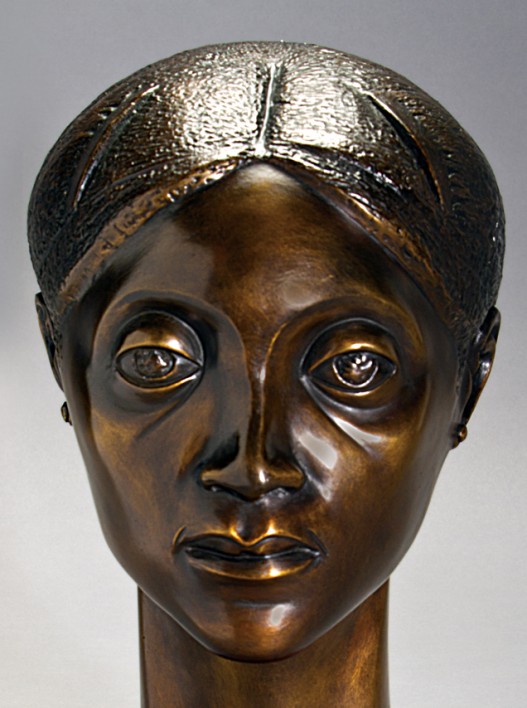
Elizabeth Catlett (American b. 1915)
Glory
Cast bronze, 1981
Drs. Osbie and Anita Herald Fund purchase,
2000.1Elizabeth Catlett’s work is bold and powerful, shaped by her social viewpoint to reveal the strength, character, and struggle of African Americans. Glory represents a frequent theme in Catlett’s work, transforming the idealized classical bust into the image of an African American woman; and, in so doing, reveals a powerful dignity, serenity, and hope.
In 1931 Catlett won a scholarship to study art at the Carnegie Institute of Technology, but was rejected admission due to her race. Instead, she attended Howard University and studied under Lois Mailou Jones. While at Howard she worked briefly for the WPA. After graduating, she worked for two years as a teacher in Durham, North Carolina where, alongside NAACP attorney Thurgood Marshall, she fought for equal wages for Black teachers.
Frustrated by the segregated South, Catlett left to study at the University of Iowa under Grant Wood. Wood’s encouragement transformed the direction of her work into one that would explore and celebrate African American culture and the lives of women. Catlett was the first student to earn an MFA in Sculpture from the university and her thesis piece, a limestone sculpture entitled Mother and Child, won first prize in sculpture at the American Negro Exposition in Chicago. While in Chicago she met her first husband, the artist Charles White.
-
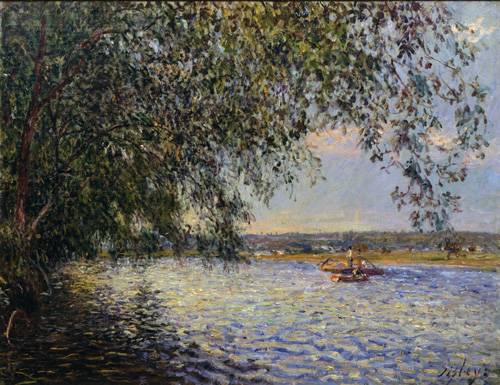
Alfred Sisley (1839-1899)
The Seine at St. Mammes
Oil on canvas, c.1867-69
Gift of Martin A. Ryerson on the 20th anniversary of the Hackley Art Gallery, 1932Alfred Sisley’s La Seine à St. Mammès was a gift of Chicago civic leader, arts patron, and connoisseur Martin Ryerson, Jr. He was an honorary trustee of the Hackley Art Gallery board and son of Martin Ryerson, Sr., one of Muskegon’s early lumber barons. While Ryerson, Jr. did not choose to give the Gallery one of his Monets, the Sisley represents Monet’s abiding influence. Indeed Monet and Sisley often painted together. The Seine was a favorite subject, exemplified in Sisley’s view of the river’s sparkling waters framed by a grand, vigorously brushed tree and the shadows cast from its overarching branches.
This subject was an unusual one for Sisley. However, in 1880 and again in 1896 and 1897, Monet painted a series of works devoted to similar tree-lined riverbanks. As the MMA’s Sisley predates these paintings, perhaps La Seine à St. Mammès was a direct influence upon Monet’s river scenes.
-
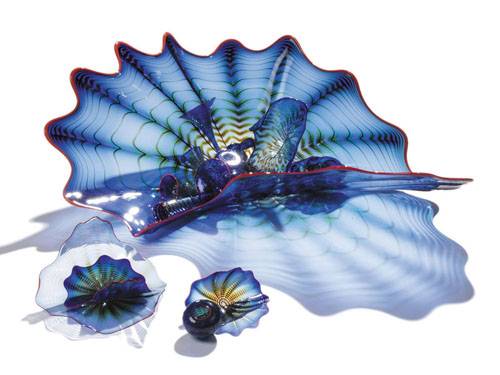
Dale Chihuly (American, b. 1941)
Cobalt Blue Persian Set with Cadmium Red Lip Wraps
Blown glass, 1972
Gift of the SPX Corporation, 2002.3a-n
photo by Frederic A. ReineckeDale Chihuly is an iconic figure in studio glass, and a household name around the world. His early work in glass, including the founding of the Pilchuck Glass School, has informed the careers of artists around the world. Chihuly was blinded in one eye in 1976, and dislocated his shoulder in 1979, ending his ability to physically blow glass. At that point, he hired assistants to create his works under direct supervision.
-
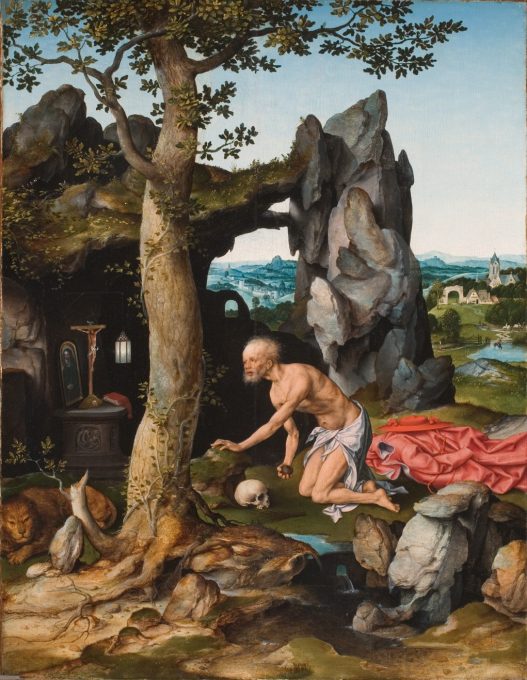
Joos van Cleve (Flemish, c. 1485-1541)
Saint Jerome in Penitence
Oil on panel, c.1516-1518
Hackley Picture Fund purchase, 1940.47This 16th-century masterpiece by Joos van Cleve depicts St. Jerome, who translated the Old and New Testaments into Latin, called the Vulgate, which is the basis for the Bible as we know it in the West today. The exotic rock formations that comprise Jerome’s “desert” were a specialty of the 16th-century Flemish painter Joachim Patinir. One of the first Flemish artists to be influenced by Patinir’s landscape was Joos van Cleve. Muskegon’s painting is the first known example of Van Cleve’s adopting Patinir’s style. Our St. Jerome was included in the seminal 2011 exhibition Joos van Cleve: Leonardo of the North, organized by the Suermondt Ludwig Museum in Aachen, Germany.
-
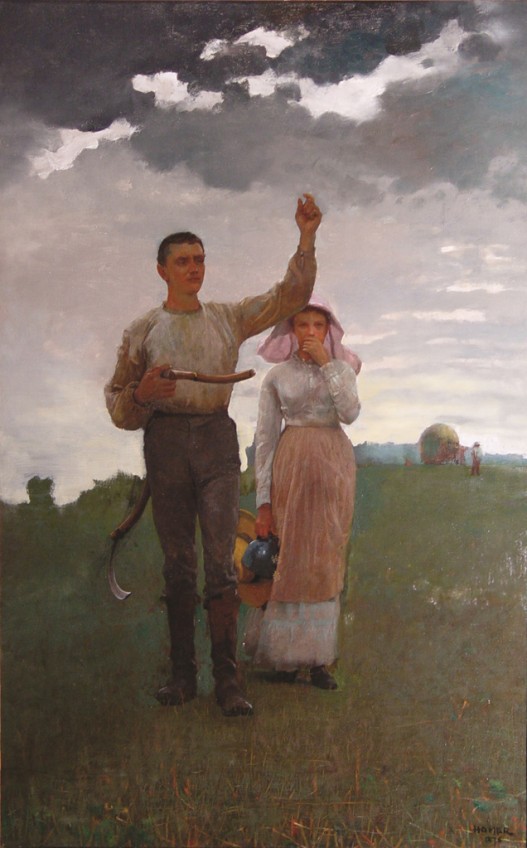
Winslow Homer (American, 1836-1910)
Answering the Horn
Oil on canvas, 1876
Hackley Picture Fund Purchase, 1927.2After a brief apprenticeship with a lithographer, Winslow Homer became a freelance illustrator for Ballou’s Pictorial in Boston, then for Harper’s Weekly in New York in 1859. Harper’s Weekly sent him to the front when the Civil War broke out, resulting in some of the most important visual reports on the war in print. Homer’s wood engravings depicted the war dispassionately, showing the mundane activities of the soldiers as often as the battles and conflicts. After the war Homer took up painting and spent time in Paris in 1866 and 1867 but, except for some Barbizon influence, was largely unchanged by the experience. Homer’s early work was often painted plein-air and depicted young men and women or children playing and working outside. His interest in the outdoors and in a simple, agrarian lifestyle, are typified in Answering the Horn, painted in 1876. In 1873, Homer began to paint in watercolor as well and used it as often as oil. Homer’s career changed markedly with a trip to the coast of England in 1881 and 1882, where the artist encountered the majesty and fury of the sea and the struggle of men and women against its power. Homer settled at Prout’s Neck in Maine along the rocky coast and the sea remained his major focus for the duration of his career.
-
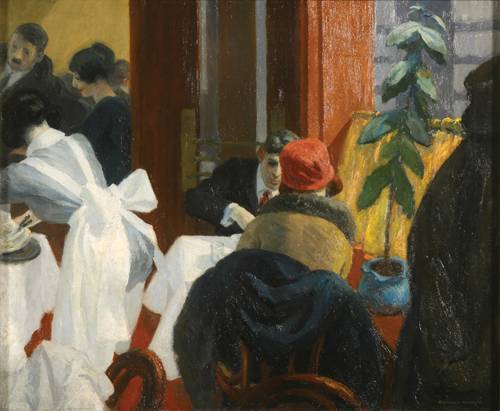
Edward Hopper (American, 1882-1967)
New York Restaurant
Oil on canvas, c. 1922
Hackley Picture Fund purchase, 1936.12Edward Hopper studied under Robert Henri and Kenneth Hayes Miller at the New York School of Art from 1900 to 1906 and also had some contact with William Merritt Chase. He made three trips to Europe, but did not enroll for formal study. Hopper was included in the 1913 Armory Show but after the exhibit he abandoned painting for the next decade, making a living as a commercial artist and refining his art through etchings and watercolors. In the early 1920s a watercolor, The Mansard Roof, was exhibited and purchased by the Brooklyn Art Museum. It laid out what would become the hallmarks of Hopper’s work: a precise sense of location; clear, harsh light; strong geometric elements; and a sense of loneliness and melancholy. His subtle observations of American life made Hopper a pivotal figure in the development of American art.New York Restaurant comes out of Hopper’s early career. While the scene is crowded, the woman in the red hat seems removed and distant, uninvolved with the man who sits with her. Hopper spoke of this painting in a letter to the MMA dated January 9, 1937: "The picture New York Restaurant was painted about 1922 – not later at any rate. In a specific and concrete sense, the idea was to attempt to make visual the crowded glamour of a New York restaurant during the noon hour. I am hoping that ideas less easy to define have, perhaps, crept in also."
-
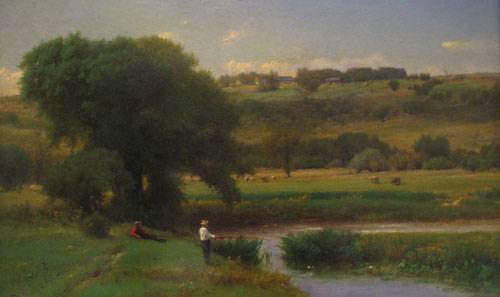
George Inness
American (1825-1894)
Landscape (Peaceful Meadows)
Oil on canvas, circa. 1878
Gift of Mr. Charles W. Marsh
1943.17George Inness was born near Newburgh, New York, in 1825, the fifth of thirteen children. Rejecting his father’s attempt to train him in the grocery business, he studied for a month with the painter John Jesse Baker in New Jersey before serving a two-year apprenticeship as an engraver with the mapmaking firm of Sherman and Smith of New York. During his early career he also studied briefly with the painter Régis Gignoux and was heavily influenced by the Hudson River School painters Thomas Cole and Asher B. Durand. Inness first exhibited at the National Academy of Design in 1844 and was named a full Academician in 1868. Two trips to Europe in the early 1850s exposed Inness to the work of the Barbizon painters and changed the direction of his work. Always interested in the notion of the connection between the real world and the spiritual one, perhaps the greatest influence on the work of Inness was his introduction to the writings of Emmanuel Swedenbourg, a Scandanavian theologian, in 1863. The Swedenborgian sect believed a spiritual essence of vitalizing and harmonizing energy flowed through the material world of appearances, an idea that resonated deeply with Inness’ artistic and pictorial goals.
While he began painting in the Hudson River School style, Inness’s exposure to the Barbizon painters and his interest in the presence of divinity in the landscape led him to the exploration of a more unified and harmonious atmosphere of light and shadow. The quiet calm and spiritual contemplation in his work became signatures of the new movement of Tonalism. Along with Whistler, Inness would influence many of the artists who would embrace that movement, including Leon Dabo and Dwight W. Tryon.
Plagued with epilepsy his entire life, Inness died in 1894 while on a recuperative trip in Scotland, having enjoyed an artistic career filled with critical and commercial success.
-
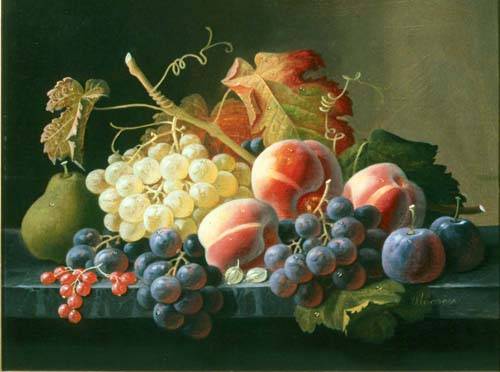
Severin Roesen
(American, born Germany, 1815-1872)
Tabletop Still Life
Oil on canvas, circa 1850
75th Anniversary Acquisition Fund, 75th Anniversary Gala Fund, the Board of Trustees, the Collections Advisory Committee, the Hackley Picture Fund, and the Friends of Art
1989.104Little is known about Roesen, though his paintings are well recognized for their 19th century popularity and wide use as “dining room pictures.” Born in Germany around 1815, Roesen likely trained as a porcelain or enamel painter. In 1848 he immigrated to New York and immediately offered his paintings for view at the American Art Union. While still lifes had a tradition in American Art, Roesen’s works achieved a new height of popularity, and were quickly purchased by New York households for display. It is speculated he ran a workshop while in New York to keep up with demand. By 1850 Roesen had married, but that year left his family to wander New York and Pennsylvania before settling in Williamsport, Pennsylvania in 1862. Williamsport was a prosperous logging town and Roesen enjoyed a following during his years there. In 1872, he disappeared, leaving a mystery as to his destination and ultimate end. He was rumored to have died on the steps of a public building in New York or in a poorhouse in Philadelphia.
The still life has been a theme in art since the early Renaissance, though it is best recognized from the 17th- and 18th-century Dutch tradition. Still life served as both a celebration of the bounty of nature and as an allegory or metaphor for spiritual and religious themes. The appearance of rot or decay in the still life bespoke the ongoing struggle between good and evil. While the still life’s prominence had faded in Europe by the 19th century, it enjoyed great popularity in America, especially among the general populace. For his collectors and admirers, Roesen’s paintings were celebrations of nature’s bounty and of the blessings of the New World.
-
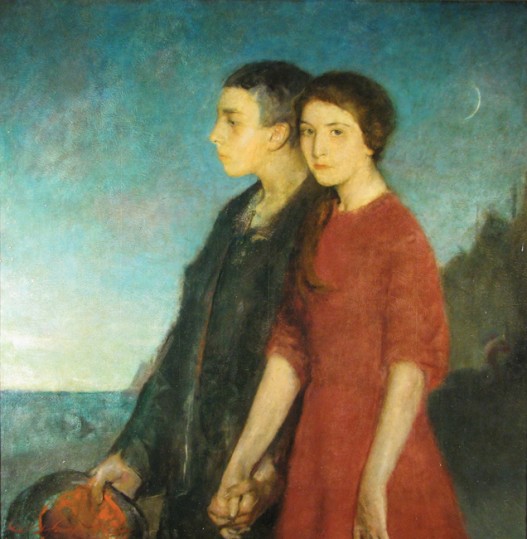
Charles Webster Hawthorne
(American, 1872-1930)
Youth
Oil on Masonite, 1910
Hackley Picture Fund Purchase
1934.33Charles Webster Hawthorne was an extremely influential figure in Provincetown, Massachusetts, both through his writings and his teachings at the Cape Cod School of Art, which he established in 1899. Hawthorne was also a founding member of the Provincetown Art Association. He studied at the National Academy of Design in New York City and was a studio assistant to William Merritt Chase at his Shinnecock Hills Long Island School.
Youth reveals a wide range of artistic influences. The blue-green background of the work and the soft lines of the figures have the muted, ethereal qualities of Tonalism, while much of the brushwork reveals an Impressionist influence. The figures, portrayed with a sense of dignity, stand together in the work in a somewhat haunting manner that is echoed by the understated, but prominent, moon over the girl’s shoulder.
-
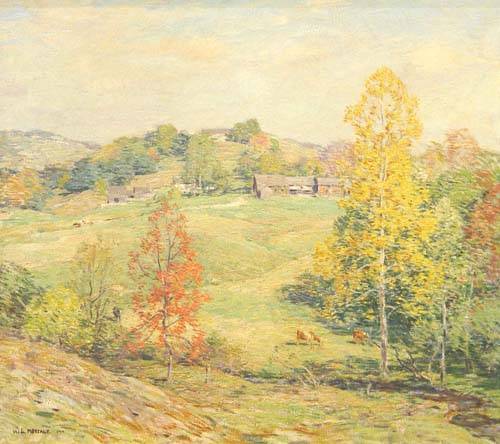
Willard Leroy Metcalf (American, 1858-1925)
Le Sillon
Oil on canvas, 1911
Hackley Picture Fund Purchase
1912.16A student at the Académie Julian in Paris from 1883–1884, Willard Leroy Metcalf was one of the pioneering American artists to spend summers at Giverny, the French town made famous by Claude Monet. Metcalf’s paintings were some of the first examples of American Impressionism to be seen stateside upon his return home in 1889. In 1897 he became a founding member of the Ten American Painters—among them Childe Hassam, John Twachtman, Frank W. Benson, Thomas Wilmer Dewing, J. Alden Wier, Edmund Tarbell, and Robert Reid—who had become dissatisfied with the restrictive practices of New York’s Society of American Artists, an organization formed in 1874 as an earlier response to the conservative nature of the National Academy of Design.
Metcalf began painting in 1874 and opened a studio in Boston in 1876. A scholarship enabled him to take art courses at the Boston Museum School and his first exhibition at the J. Eastman Chase Gallery provided him funds for travel to Europe. He studied with several artists in France, England, and Brittany and met John Twachtman and Theodore Robinson during his trip. He was painting at Giverny by 1886 and was joined by other American painters soon after. He returned to the US and opened a New York studio, finding work as a portrait painter, illustrator, and teacher, but struggled to gain any meaningful success. He traveled to Cuba in 1904 for a mural commission and began to summer at Old Lyme in 1905. His career burgeoned during this period. In 1907, he won the Corcoran Gallery of Art gold medal and his painting, May Night, became the first contemporary American painting purchased by the museum. Between 1909 and 1921 Metcalf spent time at the Cornish Art Colony in New Hampshire, the time period in which this painting was executed. He continued to travel extensively, painting around the Eastern U.S. and in Europe. In 1923, one of his paintings sold for $13,000, a record for the sale of the art of a living American painter.
Metcalf was called “the poet laureate of the New England hills” and his affection for the region’s seasonal beauty is evident in this view of the Cornish, New Hampshire countryside. In a tapestry of short, feathery brushstrokes, Metcalf takes as his subject a luminous expanse of meadow, framed in fall foliage and cut through by a furrow (sillon) that meanders up the hill to a distant farm.
-
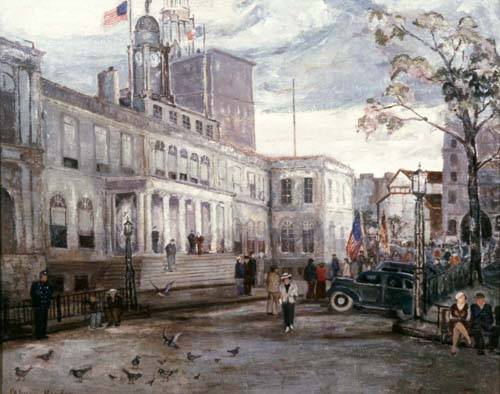
Palmer Cole Hayden (American, 1890–1973)
New York City Hall
Oil on canvas, circa 1935
Gift of the Drs. Osbie and Anita Herald Fund,
Edward and Lois Lynch, Justice and Mrs. G. Mennen
Williams, and an Anonymous Donor
2001.2Palmer Cole Hayden took his inspiration from the environment around him, focusing on the African-American experience. He tried to capture both rural life in the South and the urban scene in New York City. While many of his urban paintings were centered in Harlem, this historic site, New York City Hall, is located in Lower Manhattan.
Born Peyton Cole Hedgeman in Widewater, Virginia, Hayden moved to Washington, D.C. when he was a teenager. His first formal training came from a drawing correspondence course. He worked odd jobs before joining the Ringling Brothers Circus, where he drew portraits of performers for publicity purposes. Hayden moved about the country until he enlisted in the United States Army in 1912. In 1920, he was discharged and went to New York City in the hopes of becoming a commercial artist. He moved to the Boothbay Art Colony in 1925 under a working fellowship and in 1926 won the first Harmon Foundation Gold Medal Award, an award for distinguished achievement by an African-American in the fine arts. With the prize money and patron support, Hayden traveled to Paris to study at the École des Beaux Arts. After a solo show in 1928 and several group shows he returned to New York in 1932 and worked at a variety of part-time jobs while pursuing his art. Hayden even worked as a janitor in the Harmon Foundation’s offices, even while regularly participating in their exhibitions. He also worked for the U.S. Treasury Art Project and for the Depression-era government-funded Works Progress Administration (WPA).
Hayden developed during the Harlem Renaissance of the 1920s but did not embrace the movement’s preferences for abstraction and African subject matter. One of his best-known works, Fétiche et Fleurs, did however incorporate African objects and textiles. Hayden’s early work was of marine subjects but in New York he returned to a consciously naïve style and captured the day-to-day lives of African-Americans in urban and rural settings. His penchant for including unflattering, even stereotypical, images of blacks often placed him at odds with his peers who accused him of caricaturing blacks for the amusement of whites. Despite such criticisms, Hayden brought a distinctive African-American presence to American art.
-
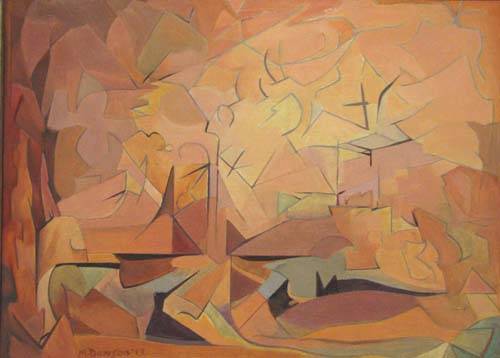
Manierre Dawson (American, 1887-1969)
Afternoon II
Oil on canvas, 1913
Gift of the Artist
1969.5Manierre Dawson was born in Chicago in 1887 and trained as an architect and civil engineer at the Armour Institute of Technology. He spent his spare time painting and his earliest works are clearly shaped by the influence of mathematical architectural ideas. In 1910 he took a leave of absence from the firm of Holabird and Roche to travel to Europe to pursue his passion for art. While in Paris he encountered Gertrude Stein, who purchased one of his paintings. When Dawson returned to the U.S. he became acquainted with Albert P. Ryder and Arthur B. Davies, the latter of which invited Dawson to submit work for the 1913 Armory Show. Although only one of his paintings was accepted into the show, its inclusion represented the single high point of Dawson’s artistic career during his lifetime.
Financial circumstances led Dawson to move to his family farm in Ludington, Michigan in 1914. The demands of running the apple orchard forced him to largely abandon painting and what time he set aside for art making he used mainly for sculpture. Shortly before his death, his work was revisited in a one-man retrospective at the Grand Rapids Art Museum in 1966. A year later the Museum of Contemporary Art in Chicago staged his first major retrospective. Dawson died in 1969.
Dawson’s painting was highly advanced for his time, arguably making him one of the first truly abstract artists. More remarkably, he came to his style of painting largely without any art training or exposure to the ideas of the time, instead deriving his unique style from his training as an architect. Dawson’s first abstract paintings actually predate those of Wassily Kandinsky, the Russian artist widely regarded as the father of abstraction. Afternoon II uses soft browns and golds to establish an autumnal mood with the complex geometric forms suggesting a landscape and in some areas a figurative presence. The abstract forms highlight Dawson’s search for a new visual language that would match his exposure to the modern age of technology and architecture.
Dawson was also a collector of art and, in 1968, along with this painting, donated to the Muskegon Museum of Art Return from the Chase by the Portuguese artist Amadeo de Souza-Cardosa. Dawson acquired Return from the Chase after its appearance in the 1913 Armory Show.
-
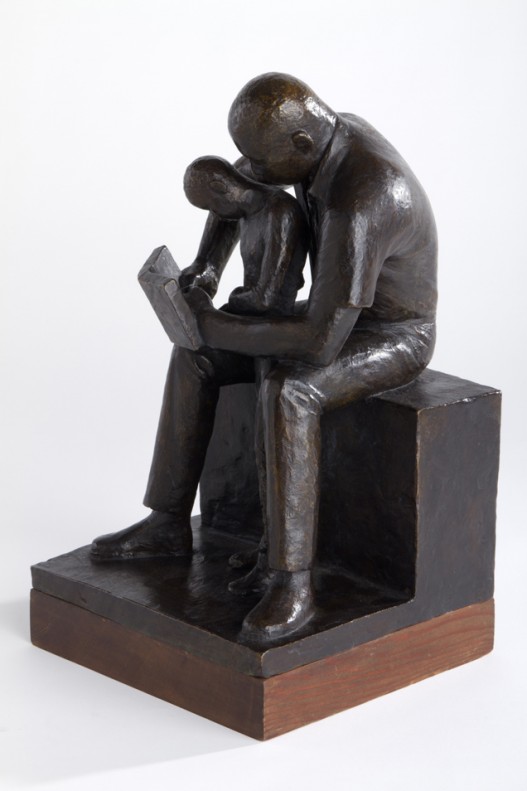
John W. Wilson
American (1922–2015)
Father and Son, 1985
bronze
Collection of the Muskegon Museum of Art, Gift of the Drs. Osbie and Anita Herald Fund, 2000.4John Woodrow Wilson is a noted sculptor, painter, and printmaker who taught art at Boston University for more than two decades. He is best known for his powerful portraits of African American men and explores themes of class oppression and racial discrimination. His work also expresses the importance of paternal presence in family life. In Father and Son, the intimate pairing of figures provides an inspirational image of a loving father and his commitment to sharing with his child the joys of reading.
A number of Wilson’s sculptures are monumental in scale. Among several commissioned works, the Muskegon Museum’s Father and Son is a study for the seven-foot sculpture installed at Boston’s Roxbury Community College (1990), and a bronze portrait of Martin Luther King, Jr. graces the Capitol Rotunda in Washington, D.C. (1988).
-
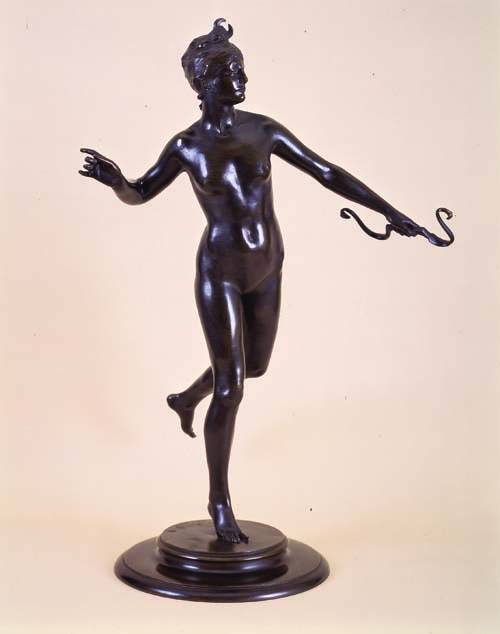
Frederick William MacMonnies (American, 1863-1937)
Diana
Bronze, 1894
Purchase, L.C. and Margaret Walker Foundation
2002.4Frederick William MacMonnies was born in 1863 in New York and studied art with his mother at an early age. At thirteen, a family financial loss forced him to work as an errand boy until, in 1880, he found work at the studio of the renowned sculptor, Augustus Saint-Gaudens. While taking night classes at Cooper Union and the National Academy of Design, he began work with Saint-Gaudens running errands and mixing clay. His artistic talents were soon recognized and he was promoted to studio assistant, allowing him to assist in creating Saint-Gaudens’ works. His time with Saint-Gaudens exposed him to the elite social circle of his mentor and he formed friendships with prominent businessmen and artists; relationships that would greatly influence and expand his career.
In 1886 MacMonnies went to Paris to study at the École des Beaux Arts with Alexandre Falguière, a sculptor whom the young artist would strive to emulate. He won the Prix d’Atelier in 1886 and debuted in the Salon in 1887 with two plaster medallions and a portrait bust. He returned to New York in 1888 to work with Saint-Gaudens for a year before returning to Paris. Diana, of which this sculpture is a reduction, won an honorable mention in the 1889 Salon. In 1891 MacMonnies received the Medal of Second Class at the Salon for two portraits. The 1891 award brought him much fame, and studio reductions of his works, or “parlour bronzes,” were soon in high demand.
In France, he taught at the Academy Vitti, at his estate in Giverny, and at the Academy Carmen with James Abbott McNeill Whistler. MacMonnies spent much of his time involved with American commissions for large-scale public works, including the Columbian Fountain for the 1893 Chicago World’s Columbian Exposition, a statue of Nathan Hale for New York’s City Hall, the Soldiers’ and Sailors’ Memorial Arch in Brooklyn, and his Pioneer Monument in Denver.
MacMonnies was one of the most highly paid sculptors of his day, and received numerous honors for his sculptures, among them an appointment as a Chevalier of the Legion d’Honor of France. In America, his works, which frequently depicted nudes, were met with controversy, and were often moved to less public locations after initial outcries. Despite his fame and early fortune, MacMonnies died in poverty in 1937, leaving behind a legacy of some of the finest Beaux-Arts public sculpture in America.
-
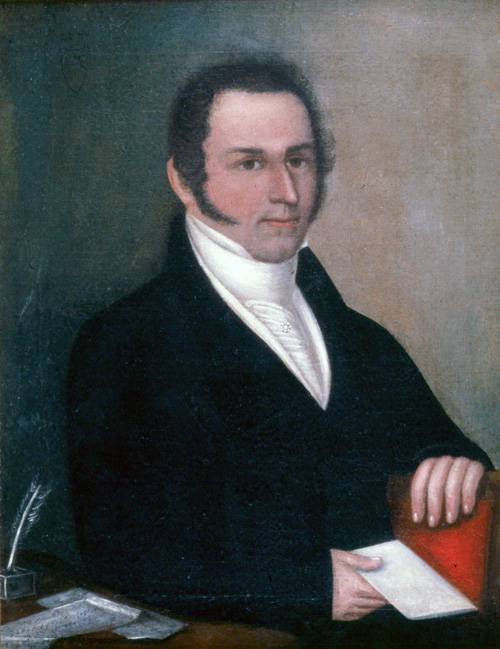
Joshua Johnson (American, active 1789-1832)
Thomas Boyle
Oil on canvas, 1815-1820
Gift of the Hackley Picture Fund, Emma Wyant, Edwin Rand Bequest, Harold Frauenthal Family, Mrs. J. Kelly Kaufman, Richard and Sylvia Kaufman, Justice and Mrs. G. Mennen Williams, Benjamin and Ruth Marcus, Ann P. and Merle J. Eichmann, Mr. and Mrs. Ted Operhall, and Mr. and Mrs. Charles E. Johnson II
1998.15Joshua Johnson was the first known African American to gain recognition as an artist in the United States. But it was not until 1939 that Baltimore genealogist and art historian J. Hall Pleasants began to piece together Johnson’s story and identify paintings believed to be by his hand. Much of Johnson’s life and work remain a mystery. We do know that he was freed from slavery by his white father, George Johnson, in Baltimore County, Maryland, in 1782, at the age of 19, and that he was active as an itinerant portrait painter in the Baltimore area from 1790 to 1825. His clients were prominent merchants, ship captains, children, and families. Most of Johnson’s commissions were for working and middle class families.
While he worked in the stylistic tradition of Charles Willson Peale and Charles Peale Polk, Johnson’s career is remarkable in that he achieved artistic success as a free black man when slavery was still legal in the U.S. Little is known about his origins; in 1796 the city directory lists Johnson as a painter and free man of color and subsequent records further indicate his status as a free man. Of his contemporaries, Johnson was the only artist to remain in Baltimore for the duration of his career, most likely due to the risk of being kidnapped and returned to slavery. This portrait is typical of Johnson’s work, and demonstrates the smaller-than-life-scale format that defined many of his portraits. The pose reflects the manner of many of the artist’s early works, as do the hand positions and props. The identity of the sitter comes from an inscription on the painting from an earlier owner, though scholarly research has proven inconclusive.
The American portrait rose from the European tradition and saw widespread popularity in the 1800s. Itinerant artists moved from city to city advertising their skills and availability, then moved on to the next location as business slowed. The portrait served as a symbol of status and prestige for the wealthy, but as artists discounted their prices and became more widespread, the appeal of portraiture spread to the lower classes. Johnson’s painting is a testament to the rich legacy of American portraiture.
-
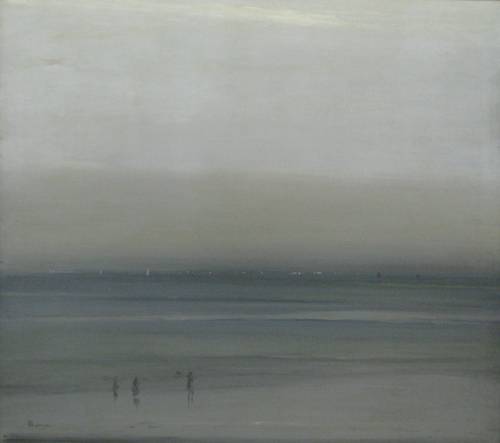
Leon Dabo (American, born France, 1864-1960)
Nassau Beach
Oil on canvas, 1912
Hackley Picture Fund Purchase
1912.21Leon Dabo was a major American Tonalist painter whose atmospheric works were closely associated with his mentor James Abbott McNeill Whistler. Dabo was one of the exhibitors in the 1910 Exhibition of Independent Artists organized by Robert Henri, John Sloan, Walt Kuhn, and Arthur B. Davies and joined them and other artists in the circle of “The Eight” as one of the principal organizers of the famed 1913 Armory Show.
Dabo was born in France to Ignace Schott and Madelaine Oberlé who settled their family in Detroit, Michigan to escape the Franco-Prussian War. He first studied art under his father, who had been a professor of aesthetics in France. The family adopted the name of Scott, though Leon would later assume the surname of “Dabo,” after the village of New Dabo in France. In 1883, after the death of Ignace, the family moved to New York City where Dabo worked as an architectural designer. While in New York he became a student of John La Farge. Through La Farge’s introduction to de Chavannes, Dabo was able to study in Paris at the École nationale supérieure des arts décoratifs, the Académie Colarossi, and the École des Beaux-Arts. He also studied at the Academy of Fine Arts Munich and for three years in Italy. He moved to London around 1886, where he became an acquaintance of Whistler. Dabo returned to New York in 1890. While in New York he saw Charles Freer’s Whistler Collection, which was to profoundly influence his career. In 1910 he participated in the “Independents” exhibit organized by The Eight and was a principle organizer of the 1913 Armory Show. In 1944, he was elected a full Academician of the National Academy of Design.
Back in New York, Dabo was soon exhibiting internationally to great critical acclaim and immersed himself in the changing art scene, becoming a member of numerous artist associations in both Europe and the United States. He returned to Europe during World War I where his linguistic skills enabled him to aid the French and British armies in counter intelligence and espionage, earning him the French Chevalier Legion of Honor Award. After the war, he traveled and lectured at art colonies and women’s clubs around the U.S. and began to paint floral subjects. After brief returns to France before and after World War II he settled in Manhattan, where he died in 1960.
Dabo is best remembered as a Tonalist, indeed being referred to as “the Poet of Color” during his career. Having studied under Whistler, Dabo was greatly interested in the decorative qualities of Whistler’s work and of Japanese art, as well as the sense of quiet poetry and harmony he achieved through his subtle use of color, value, and shape. Nassau Beach appears as if in a fog, filled with warm grays and hints of blue. Forms are hazy and indistinct, lending an air of mystery to the scene and emphasizing a sense of the ethereal.
-
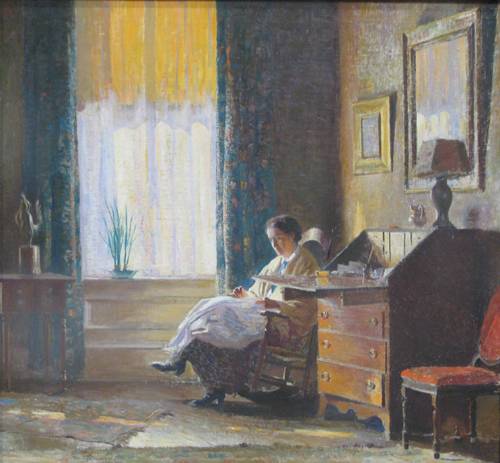
Daniel Garber (American, 1880–1958)
Interior, Green Street
Oil on canvas, 1924-25
Hackley Picture Fund Purchase
1934.32Though his primary interest was landscape, Garber also had great success with interior works. Interior, Green Street is a genre painting of Garber’s wife quietly stitching while rocking in the corner of a sun-lit room. The attention to light in the work, as it relates to the mood of a scene, is common in Garber’s work. Garber studied at the Cincinnati Academy and later at the Pennsylvania Academy of the Fine Arts where he was inspired by the works of Thomas Eakins. Garber went on to study in Europe but brought little of the European artistic ideals back with him to the United States, where he became a faculty member at his alma-mater, the Pennsylvania Academy of the Fine Arts. Like many of his contemporaries, Garber was a member of the National Academy.
-
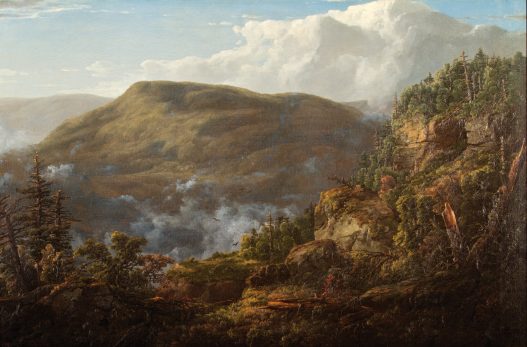
William Louis Sonntag (American, 1822-1900)
Mountain Landscape
Oil on canvas, 1854
Hackley Picture Fund Purchase
1912.8Sonntag’s early career was markedly influenced by Thomas Cole and the Hudson River aesthetic, of which this painting is a fine example. Depicting a rugged, untamed landscape bereft of human presence, this painting embraces the mid-19th century belief that art was an interpreter of nature, which in turn was an interpreter of God. Celebrating meditation of the divine, landscape painting revealed the face of God in every aspect of nature and is most notably here in the distant, inaccessible mountain form rising from the mists, a metaphor for an awesome, monotheistic deity. The three trees in the bottom left of the painting might also be interpreted as three crosses. The depiction of such virgin landscapes also instilled in American viewers a sense of nationalist pride as they contemplated the majesty of their land and the vast potential for expansion.
William Sonntag was born in rural Pennsylvania and at an early age aspired to be a landscape artist. After failed apprenticeships to a carpenter and architect, William Sonntag is thought to have studied at the Cincinnati Academy of Fine Arts. By the mid-40s he was established as an itinerant painter, selling paintings and sketches as he traveled the Ohio Valley. A storefront exhibition in Cincinnati drew the attention of the Baltimore and Ohio Railroad, which commissioned the artist in 1846 to paint a series of views along the railroad’s route, in hopes of attracting tourists and settlers. In 1855 Sonntag traveled to Florence to study for a year, then settled in New York where he resided permanently after 1860.
After 1860 Sonntag’s style matured and into the 1870s he enjoyed substantial artistic recognition. He was awarded full academic status in the National Academy of Art in 1862. Upon his death in 1900 his works became largely forgotten, awaiting the current renewed interest in 19th century American painting.
-
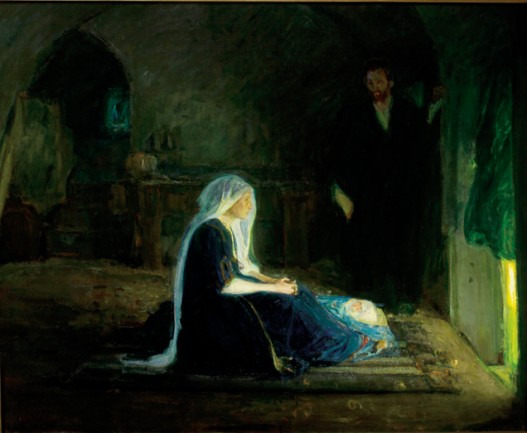
Henry Ossawa Tanner
American, 1859 –1937
The Holy Family, ca. 1910
Oil on canvas
Muskegon Museum of Art. Hackley
Picture Fund Purchase, 1911.1Henry Ossawa Tanner was an esteemed painter of religious subjects, of which The Holy Family is a prime example. Tanner paints a tender, family scene in a simple interior like those he found in the Holy Land. Prior to completing this painting and numerous other biblical scenes, Tanner traveled to Palestine, Morocco, and Algeria in order to observe and incorporate the historical essence of those locations.
The wood shavings on the floor identify the setting as the workplace of Joseph the carpenter, who stands in the shadows observing mother and child. Mary wears a halo-like veil and is the center of the painting. Her face is illuminated from a source beyond the curtained doorway. The light is realistic, but also symbolic of a divine light surrounding Mary and her Child.
In February 1911, the first Chicago exhibition of the artist’s paintings was held. Tanner, who had spent most of his career in Paris, attended the opening. It was from this exhibition that the Muskegon Museum of Art acquired the painting—the first work by an African American artist in the collection. The Chicago Daily Tribune noted the painting’s “quality of spiritual mystery,” as well as its “serene and lofty poetic feeling.”
-
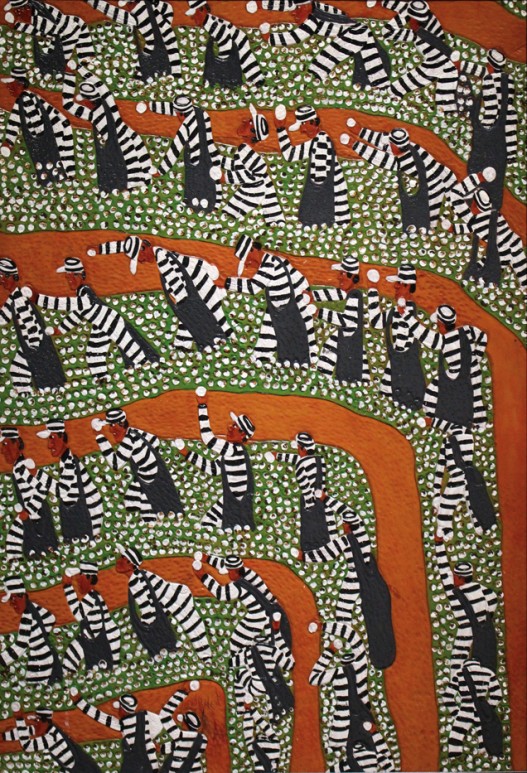
Winfred Rembert (American, born 1945)
Chain Gang Picking Cotton #2
Dye on carved and tooled leather, 2004
Museum purchase, through funds provided by the
Van Kampen Art Fund
2015.9As Winfred Rembert recalled: “Chain gang work is the worst work under the sun. I know because I spent seven years on one. It never got too cold or too hot to work. Snakes and bees can be a problem. Picking cotton on the chain gang is just hard. The sun is really hot and water is not plentiful. (From a handwritten statement, Adelson Galleries archives)
Rembert learned to hand tool leather while incarcerated at a maximum-security prison in Reidsville, Georgia, where he crafted billfolds with simple geometric designs. After his release, Rembert married, moved north, and found employment as a longshoreman in Bridgeport, Connecticut. He began to craft leather again at his wife’s suggestion. She encouraged him to visually record the story of his life: growing up in the segregated South; doing backbreaking work on a cotton plantation; joining civil-rights rallies as a follower of Martin Luther King, Jr.; his arrest and near lynching; seven years in jail; and hard labor on the chain gang.
Rembert’s tooled leather paintings resonate with a painful past, but they can portray happier memories as well, recalled of his hometown of Cuthbert, Georgia. For an artist with no formal training, he exhibits remarkable talent as both a creator and a storyteller. He has elevated prison-learned craft to museum-worthy art.
The intense patterning of Chain Gang Picking Cotton #2 is a phenomenal aspect of this work, not only visually, but reflective of cotton planting. Despite Rembert’s experience of cotton picking as a brutal job, he also remarked “I must admit that the cotton field was a pretty place. The farmers did a beautiful job of patterning the rows, so if you happen to ride by or pass a cotton field, it’s a beautiful sight. Some rows to the left, some to the right, and some straight.”
-
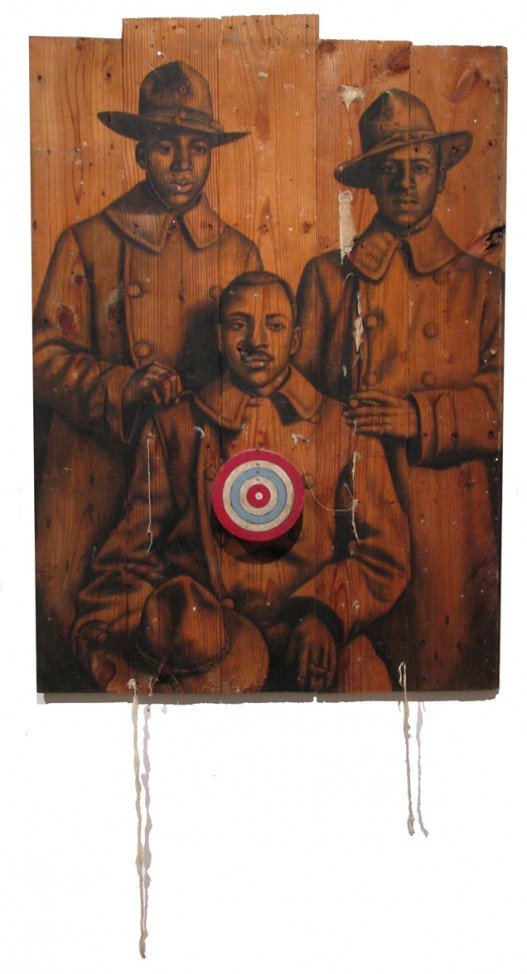
Whitfield Lovell
(American, born 1959)
At Home and Abroad
Conte crayon on wood with target, nails, and fabric, 2008
Purchased in honor of the 100th Anniversary of the Muskegon Museum of Art through the Art Acquisition Fund, the 100th Anniversary Art Acquisition Fund, the support of the Alcoa Foundation, and the gift of Dr. Anita Herald
2010.2Whitfield Lovell is one of the most highly regarded African American artists working today. At Home and Abroad is a fine example of Lovell’s work—a tableau wherein a group of persons and found objects create a striking, thought-provoking scene. With superb draftsmanship, three portraits of World War I soldiers are portrayed and juxtaposed with a prominent red, white, and blue target. One of Lovell’s most powerful themes, that of patriotism and oppression, is illustrated: the ironic image of the African American soldier who serves a country that did not afford him basic human rights.
-
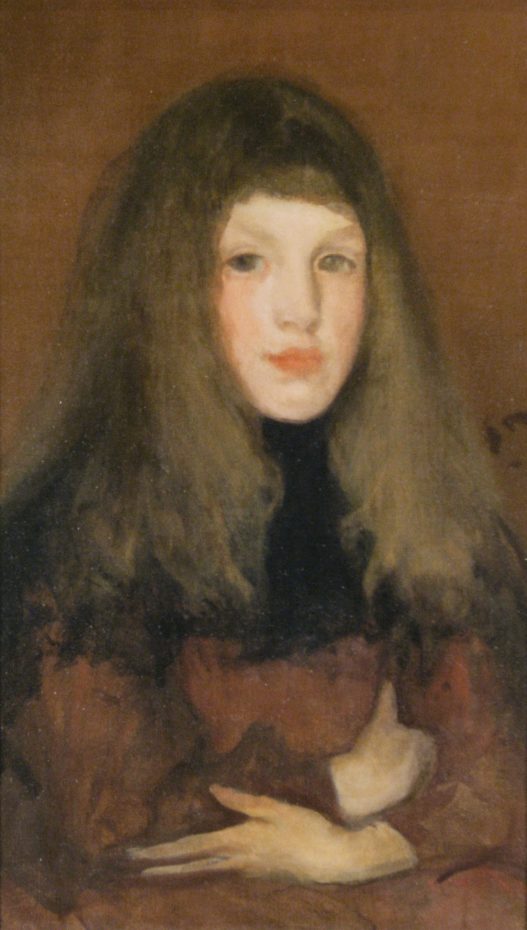 James Abbott McNeill WhistlerAmerican, 1834-1903A Study in Rose Brownoil on canvascirca 1895Muskegon Museum of ArtHackley Picture Fund Purchase1914.21
James Abbott McNeill Whistler was born in 1834 in Lowell, Massachusetts. His first art training was in 1845 at the Imperial Academy of Fine Arts in St. Petersburg, where his father served as a civil engineer for the St. Petersburg-Moscow railway. Whistler attended West Point from 1851 to 1854, but excelled only at art and was dismissed from the academy. In 1855 he traveled to Paris to study with Charles Gleyre and eventually met and befriended artists Henri Fantin-Latour and Gustave Courbet. Whistler began his career as an etcher, and during his lifetime was acknowledged as the greatest exponent of etching since Rembrandt. He moved to London in 1859 and attempted to spread French Realism to England. Very quickly his direction changed however, as he became interested in the aesthetics of the art of Japan and the new movement towards Impressionism in France, and he began to incorporate those ideas into his work. Whistler was rejected from the Salon of 1863, but was included in the seminal Salon des Refusés with artists such as Manet and Pissarro. Whistler came into his maturity in the 1870s with his Nocturnes, fully embracing the idea of art for art’s sake and abandoning precise realism to instead emphasize the beauty of pictorial effect and design. Whistler’s personality made him a controversial figure, and he made enemies as quickly as he did friends.
Whistler had a profound effect on the rise of Impressionism in America. While never fully an Impressionist himself, he worked aggressively to promote European Impressionist works and his style influenced many of the artists that would define American Impressionism. The Tonalists owe a huge debt to Whistler’s subtle colors and tones, the hallmarks of their movement.
A Study in Rose and Brown was painted shortly before the artist’s death in 1903. Whistler met the subject, Rosie Rendall, during a trip to the village of Lyme Regis in Dorset. The painting bears all the hallmarks of Whistler – the atmospheric handling of tone and color, a flat, almost decorative picture plane, and the simple but elegant rendering. A Study in Rose and Brown appeared in the 1905 Memorial exhibit to the artist and in the 1913 Armory Show. When it was purchased by the MMA at the close of the Armory Show, the painting was at the forefront of avant-garde modernism.
-
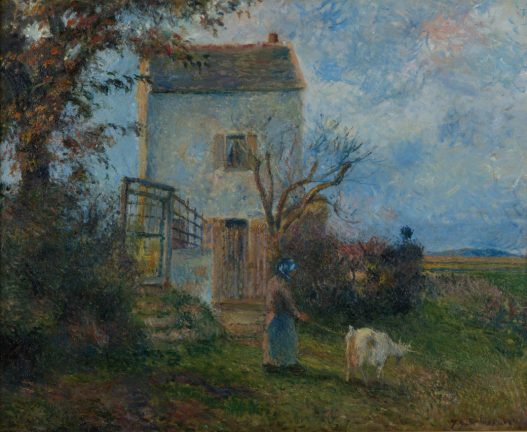
Camille Pissarro (French, 1830-1903)
La Ferme (The Farm)
Oil on canvas, 1879
Gift of the L.C. and Margaret Walker Foundation
1976.18Camille Pissarro was a critical figure in the development of Impressionism and over his long career he associated with some of the most famous artists of his time, including Gustave Courbet, Jean-Baptiste-Camille Corot, Paul Cézanne, Alfred Sisley, Georges Seurat, Claude Monet, Jean-François Millet, Armand Guillaumin, Mary Cassatt, and Paul Signac.
Pissarro was born in St. Thomas in what was the Danish West Indies. While a Danish citizen by birth, his father was French, and so he was sent to a boarding school outside of Paris at the age of 12. Pissarro returned to St. Thomas at 17 and, while working in his father’s business as a cargo clerk, pursued art in his free time. While in St. Thomas he met the Danish artist Fritz Melbye who encouraged him to pursue art full-time and the pair spent the next several years painting in Venezuela. Pissarro returned to Paris in 1855 to study with Fritz’s brother, Anton Melbye.
Pissarro admired the paintings of Gustave Courbet and the Barbizon School and, like many artists of the day, took courses at the École des Beaux-Arts and Académie Suisse. Chafing at the strictures of academic training, he took lessons from Camille Corot, who encouraged him to paint outdoors. In 1859, he befriended Monet, Guillaumin, and Cézanne and became the informal leader of their growing circle. Pissarro and Cézanne exhibited in the 1863 Salon des Refusés and Pissarro was instrumental in the formation of the Société Anonyme des Artistes, Peintres, Sculpteurs et Graveurs, which held the first “impressionist” exhibition in 1874, to great public and critical controversy. When he met Georges Seurat and Paul Signac in 1885 Pissarro adopted many of their techniques, including the pointillism that characterized their Neo-Impressionist style, though he returned to his earlier way of working after several years, feeling the Impressionist manner that had defined his career to be more natural and true to the world. He also returned to the subject matter of his earliest works, focusing on the peasants at work in the countryside.
La Ferme reflects Pissarro’s passion for the rural landscape and the people who lived and worked there, as well as his changing style of painting. During the 1870s his brushwork became looser, with fewer blended lines and colors, allowing each mark to stand out, resulting in a more expressive manner of painting. La Ferme was likely painted near the town of Pontoise, outside of Paris, where Pissarro made his home from 1866 to 1883.
-
Roger Brown (American, 1941-1998)
Painter of a Bird's Eye View
Oil on canvas, 1980
Purchased in honor of the 100th Anniversary of the
Muskegon Museum of Art through the Art Acquisition Fund
and the 100th Anniversary Art Acquisition Fund
2010.1Roger Brown was one of the most celebrated of the Chicago Imagists. Born in Alabama, he maintained a lifelong affinity not only for the South but for the outsider and folk art he encountered in his youth. In 1962 he moved to Chicago and in the following years alternated study at the American Art Academy and the School of the Art Institute of Chicago. He eventually received a BFA and MFA from the SAIC in 1968 and 1970. He had his first solo show at Phyllis Kind Gallery in Chicago in 1971 and quickly achieved national critical acclaim. He was associated with other artists of the Chicago area, who became dubbed the “Chicago Imagists,” artists whose work was characterized by sometimes rough, expressive stylization, the incorporation of pop culture images and aesthetics, and an interest in contemporary social and political issues. Brown was also a participant in the famous “The Hairy Who” exhibition. He maintained his lifelong passion for outsider art, amassing a significant collection and inspiring much of the contemporary interest in folk art
Painter of a Bird's Eye View, with its considerable scale, compelling patterning, and cartoon or comic-like figures, is highly representative of the artist’s style and subject matter. In the foreground, at the bottom right of the painting, an artist stands at his easel, creating the scene before him.
-
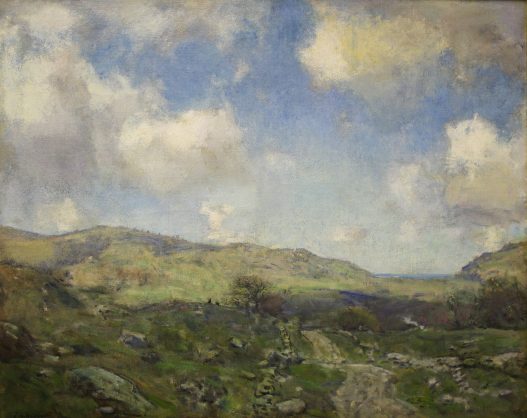
Charles Harold Davis (American, 1856-1933)
In April
Oil on canvas, not dated
Hackley Picture Fund Purchase
1911.3Charles Harold Davis was born in Amesbury, Massachusetts in 1856. He began his career in a carriage factory but, after seeing an exhibition of French Barbizon School painting that featured the works of Jean Francois Millet, enrolled at the Boston Museum of Fine Arts in 1877. In 1880, a local businessman gave Davis a thousand dollars to study in France, where he lived for the next decade. While in France, Davis studied at the Académie Julien with Jules Lefebvre and continued to be heavily influenced by the Barbizon style. He displayed regularly at both the Paris Salon and the Paris Exposition and sent works back to the United States for frequent one-man shows at Doll and Richards Gallery in Boston.
In 1891 Davis returned to the States with his French wife, Angele Legarde, and the two settled in Mystic, Connecticut. The rural Mystic area provided him with the subject matter for his landscapes, which quickly became Impressionist. In 1892, he founded the Mystic Art Colony and, by 1895, he was focused primarily on the theme of clouds, using a low horizon line to emphasize the forms and movement of the clouds and the open, brilliant blues of the sky. In April likely comes from this period, due not just to the subject matter but as well to the loose Impressionist brushwork and emphasis on the quality of light. While In April is certainly an Impressionist painting, the soft greens and grays and the subtle transition from light to shadow across the landscape hint at the Tonalist style of Davis’ early career and lend a sense of quiet and stillness to the painting.
Davis’ paintings won numerous prizes and medals during his career and he enjoyed both critical and commercial success in his lifetime. He was exhibited at the Chicago Art Institute, the Corcoran Gallery, and the National Academy and his works were shown in major national and international exhibitions, including the Universal Exposition of 1889 in Paris, the Armory Show of 1913, and the Pan-Pacific Exposition in 1915. Davis died in Mystic at the age of 77.